.git_0001 — Continuity Is Infrastructure
Most AI systems treat continuity as conversational memory.
Memex approaches continuity differently.
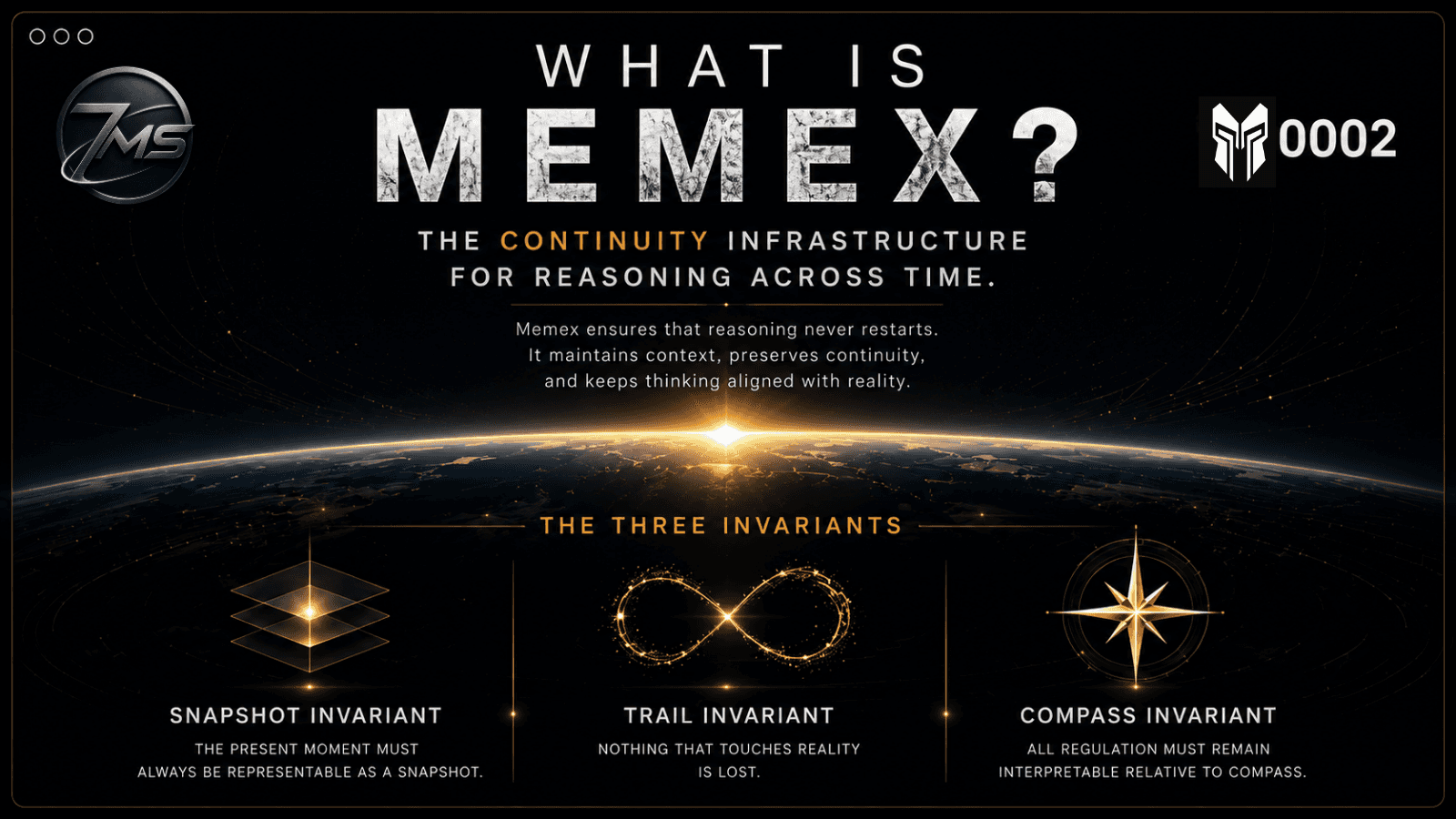
Continuity is treated as runtime infrastructure for preserving reasoning continuity, operational state, and workflow context across interrupted AI-assisted work.
This distinction changes the architectural boundary entirely.
The goal is not to preserve every token, interaction, or generated output.
The goal is to preserve the structured continuity conditions required for reasoning, development workflows, and long-horizon operational work to continue across time without repeated reconstruction.
The system therefore separates:
Memex = continuity runtime
Model = reasoning compute
Memex = continuity runtime
Model = reasoning compute
Memex = continuity runtime
Model = reasoning compute
Reasoning engines may evolve.
Continuity structure must remain stable.
This architectural boundary exists because long-running AI-assisted work accumulates continuity pressure over time.
As sessions fragment across tools, repositories, and runtime environments:
assumptions drift
unresolved architectural boundaries disappear
operational grounding weakens
repository awareness collapses
workflow continuity degrades
reasoning becomes increasingly local
interrupted work requires repeated onboarding and reconstruction
Most systems attempt to compensate through:
summaries
retrieval
generated memory
conversational reconstruction
context-window expansion
Memex instead attempts to preserve explicit continuity state.
The architecture organizes continuity around five primitives:
Compass = purpose
Snapshots = continuity time
Trails = memory
Loops = regulation
Reality = grounding
Compass = purpose
Snapshots = continuity time
Trails = memory
Loops = regulation
Reality = grounding
Compass = purpose
Snapshots = continuity time
Trails = memory
Loops = regulation
Reality = grounding
Together, these structures regulate continuity across sessions, repositories, runtime boundaries, and long-horizon reasoning workflows.
Snapshots preserve structured continuity state required for restoring interrupted work.
Trails preserve observed continuity evidence and operational progression across time.
Reality grounding prevents generated interpretation from replacing operational truth.
Loops regulate continuity drift relative to Compass.
The runtime intentionally prefers:
instead of:
Missing continuity remains visible.
Observed operational reality outranks interpretation.
This distinction becomes increasingly important as continuity systems evolve across:
repositories
development workflows
runtime environments
operational timelines
AI-assisted reasoning systems
multi-session project execution
long-horizon cognition
Without stable continuity semantics:
summaries replace evidence
navigation appears authoritative
unresolved seams disappear
operational context fragments
workflow continuity collapses silently
continuity drift compounds over time
The runtime therefore preserves explicit distinctions between:
observed truth
declared truth
projected truth
derived truth
A continuity system becomes unstable when these layers collapse into each other.
Continuity depends on stable semantic boundaries.
This is also why Memex models unresolved architectural pressure directly through seams.
A seam is not a task.
A seam is an active unresolved boundary within continuity, implementation, or operational reasoning.
The next action represents the move applied to that boundary.
current_seam != next_action
current_seam != next_action
current_seam != next_action
This distinction helps continuity remain structurally stable across sessions, implementation cycles, and evolving repositories.
Operational trails preserve observed continuity evidence across time.
Repo cognition preserves structural continuity across evolving codebases and long-running development systems.
Rehydration restores continuity state without reconstructing missing operational context through narrative approximation.
The runtime repeatedly enforces the same constraint:
Do not silently mutate continuity.

Do not invent missing state.

Do not collapse uncertainty into certainty
Do not silently mutate continuity.

Do not invent missing state.

Do not collapse uncertainty into certainty
Do not silently mutate continuity.

Do not invent missing state.

Do not collapse uncertainty into certainty
Memex does not attempt to simulate persistent intelligence.
It attempts to preserve the continuity conditions required for reasoning, workflow continuity, and operational cognition to remain coherent across time.
The architecture remains under active evolution.
The invariants remain stable:
Compass anchors purpose
Snapshots structure time
Trails preserve memory
Reality grounds observation
Loops regulate continuity
Continuity is not treated as memory.
Continuity is treated as infrastructure.