


The Hidden Cost of Re-Explaining Yourself to AI
Repeated operational reconstruction quietly destroys long-running AI workflow momentum
by
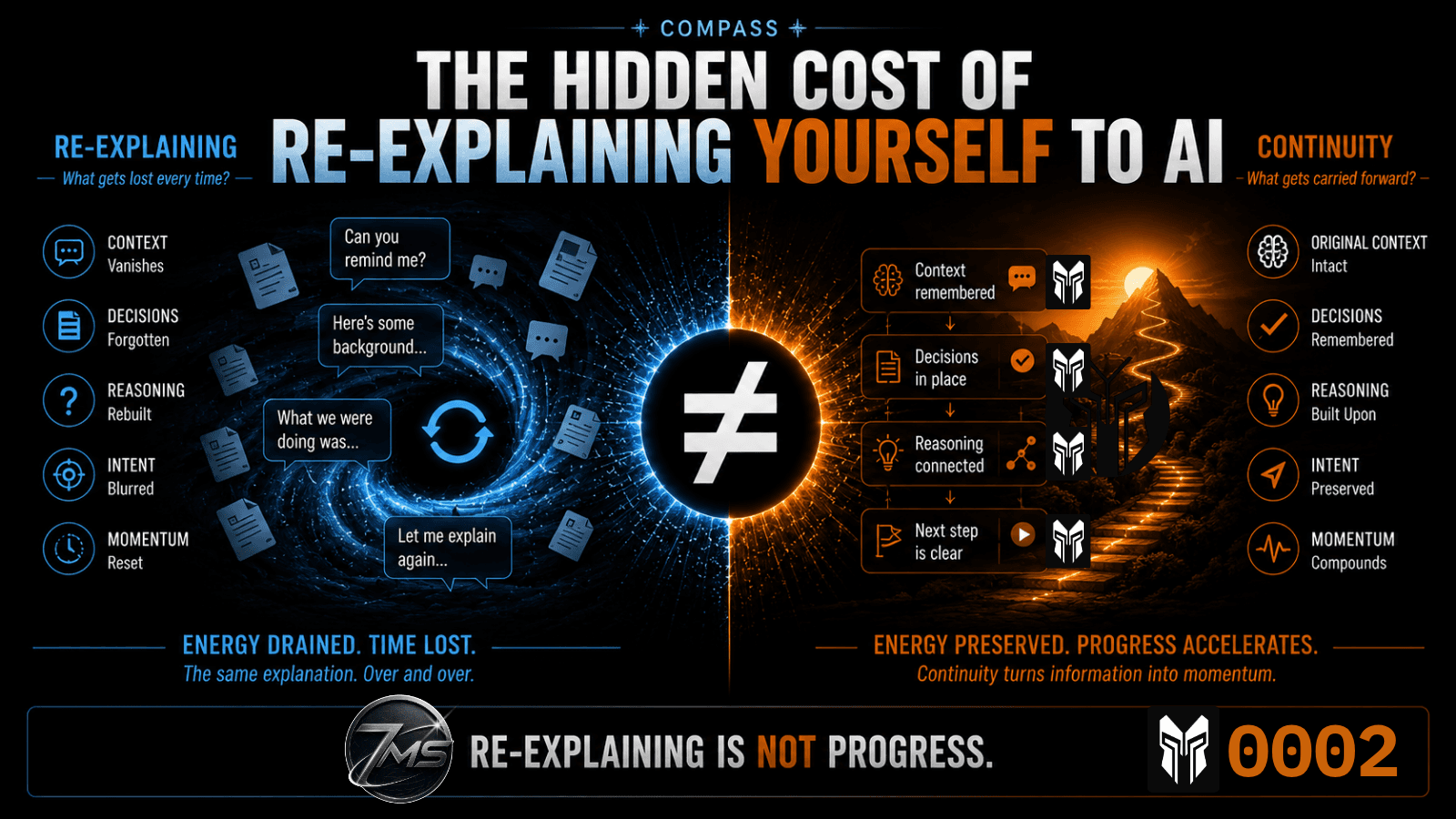
Most AI systems fail quietly.
Not because the reasoning becomes unintelligent.
Because continuity collapses between sessions.
The failure usually appears small at first.
A little context disappears.
A project requires re-explanation.
An architectural decision gets forgotten.
A workflow resumes slightly off trajectory.
Then the cycle repeats often enough that something operational starts breaking underneath the surface.
The system becomes exhausting to work with.
Not because it cannot reason.
Because it cannot continue.
Most long-running AI workflows eventually accumulate reconstruction pressure.
A session ends.
A context window expires.
A repository evolves.
A runtime changes.
Then the next session begins with reconstruction:
re-explaining the project
restoring architecture context
recovering implementation direction
rebuilding assumptions
re-establishing priorities
reconstructing unresolved boundaries
recovering workflow state
At first this feels manageable.
Then the continuity tax compounds.
Over time, the operational drag becomes larger than the reasoning itself.
The system may still generate intelligent outputs.
But continuity underneath the workflow begins fragmenting.
Most AI systems already preserve large amounts of information.
They preserve:
conversation history
summaries
retrieval fragments
message archives
generated outputs
vector memory
But preserved information is not the same thing as preserved continuity.
Long-running operational work depends on more than stored text.
It depends on preserving:
continuity trajectory
unresolved seams
operational grounding
reasoning orientation
continuity lineage
active architectural pressure
implementation direction
When those structures disappear, the work no longer feels resumable.
It feels reconstructed.
That distinction becomes increasingly visible during:
long-running AI-assisted development
evolving operational systems
multi-session reasoning workflows
repository-scale architecture work
interrupted implementation cycles
long-horizon research systems
The reasoning may still appear capable.
But the continuity state underneath it has collapsed.
Humans are surprisingly tolerant of imperfect reasoning.
What they are not tolerant of is repeated continuity reconstruction.
Because every reconstruction cycle introduces operational entropy.
Important state fragments across:
temporary context windows
disconnected files
undocumented assumptions
generated summaries
fragmented runtime state
isolated conversations
As continuity weakens:
reasoning becomes increasingly local
unresolved boundaries disappear
architectural context fragments
operational grounding weakens
implementation direction drifts
continuity momentum degrades
Eventually the system stops feeling collaborative.
It starts feeling fragile.
The workflow becomes dominated by continuity repair instead of forward progress.
Most discussions about AI memory frame the problem incorrectly.
The problem is not merely whether information survives.
The problem is whether operational trajectory survives interruption.
A system may preserve every historical message while still losing:
continuity shape
directional cognition
operational coherence
unresolved context
continuity momentum
active reasoning boundaries
This is why many AI workflows feel unstable even when the system technically “remembers” previous conversations.
The continuity state required for reasoning to continue naturally has already degraded.
The system remembers fragments.
It loses trajectory.
Memex approaches continuity differently.
The system treats continuity as runtime infrastructure rather than passive memory storage.
At its core:
Models perform reasoning compute.
Memex preserves the continuity structures that allow reasoning continuity to persist across time.
This includes preserving:
structured continuity state
continuity lineage
operational grounding
active seams
continuity trajectory
resumable workflow state
continuity restoration pathways
The objective is not simulated persistence.
The objective is resumable continuity.
Long-running reasoning systems accumulate continuity pressure over time.
Especially across:
interrupted sessions
tooling evolution
repository mutation
runtime instability
architecture drift
evolving operational systems
Most systems treat interruption as failure.
Memex treats interruption as an architectural condition.
The runtime attempts to preserve enough continuity structure for reasoning to resume without rebuilding the entire operational state manually.
This includes preserving:
current objective
current seam
next action
continuity trajectory
operational evidence
unresolved system boundaries
The goal is not replaying every previous thought.
The goal is preserving the continuity conditions capable of regenerating the reasoning trajectory naturally after interruption.
Most AI systems restart from approximation.
Memex approaches interruption through rehydration.
The runtime treats rehydration as continuity restoration rather than memory approximation.
The objective is not recreating perfect historical memory.
The objective is restoring:
continuity shape
operational grounding
active seams
continuity lineage
implementation direction
unresolved continuity state
The system intentionally avoids:
fabricated continuity
hidden inference
semantic rewriting
reconstructed assumptions
invented operational state
Missing continuity remains visible.
Explicit gaps are preferred over invented continuity.
Because continuity systems become unstable when generated interpretation replaces operational grounding.
Observed operational reality remains authoritative.
Short conversations hide continuity failure surprisingly well.
Long-running work does not.
As AI-assisted systems expand across:
repositories
operational timelines
evolving architectures
runtime environments
multi-session workflows
long-horizon implementation cycles
continuity becomes more important than isolated outputs.
The instability is no longer reasoning quality alone.
The instability is continuity fragmentation across time.
This is why continuity infrastructure eventually becomes necessary.
Not because models are incapable.
Because operational reasoning requires continuity conditions capable of surviving interruption.
Most AI systems preserve conversational history.
Memex preserves structured continuity state.
That distinction becomes operationally important once workflows become large enough that restarting cognition every session starts feeling absurd.
The problem is not merely memory.
The problem is continuity collapse.
At its core:
Memex exists to preserve the conditions required for reasoning continuity across time.