

Why AI Memory Is Solving The Wrong Problem
Most efforts to improve AI focus on memory. But memory may not be the real bottleneck. The deeper challenge is continuity—preserving the conditions required for reasoning to continue across time.
by
Most discussions about the future of AI eventually arrive at the same conclusion:
AI needs better memory.
The assumption feels obvious.
If models forget things, then memory must be the missing ingredient.
As a result, enormous effort has gone into:
larger context windows
vector databases
retrieval systems
memory layers
long-term storage
The goal is always the same:
Help the model remember.
But what if memory is not the real problem?
When people talk about AI memory, they usually imagine something similar to human recall.
An experience occurs.
The experience is stored.
The experience is retrieved later.
The model therefore becomes more capable over time because it remembers more things.
This framing feels intuitive.
It is also incomplete.
Consider a long project.
The model may remember:
the project name
previous conversations
technical decisions
requirements
And yet continuity still breaks.
The project stalls.
Context must be re-explained.
Decisions are revisited.
Work is repeated.
Why?
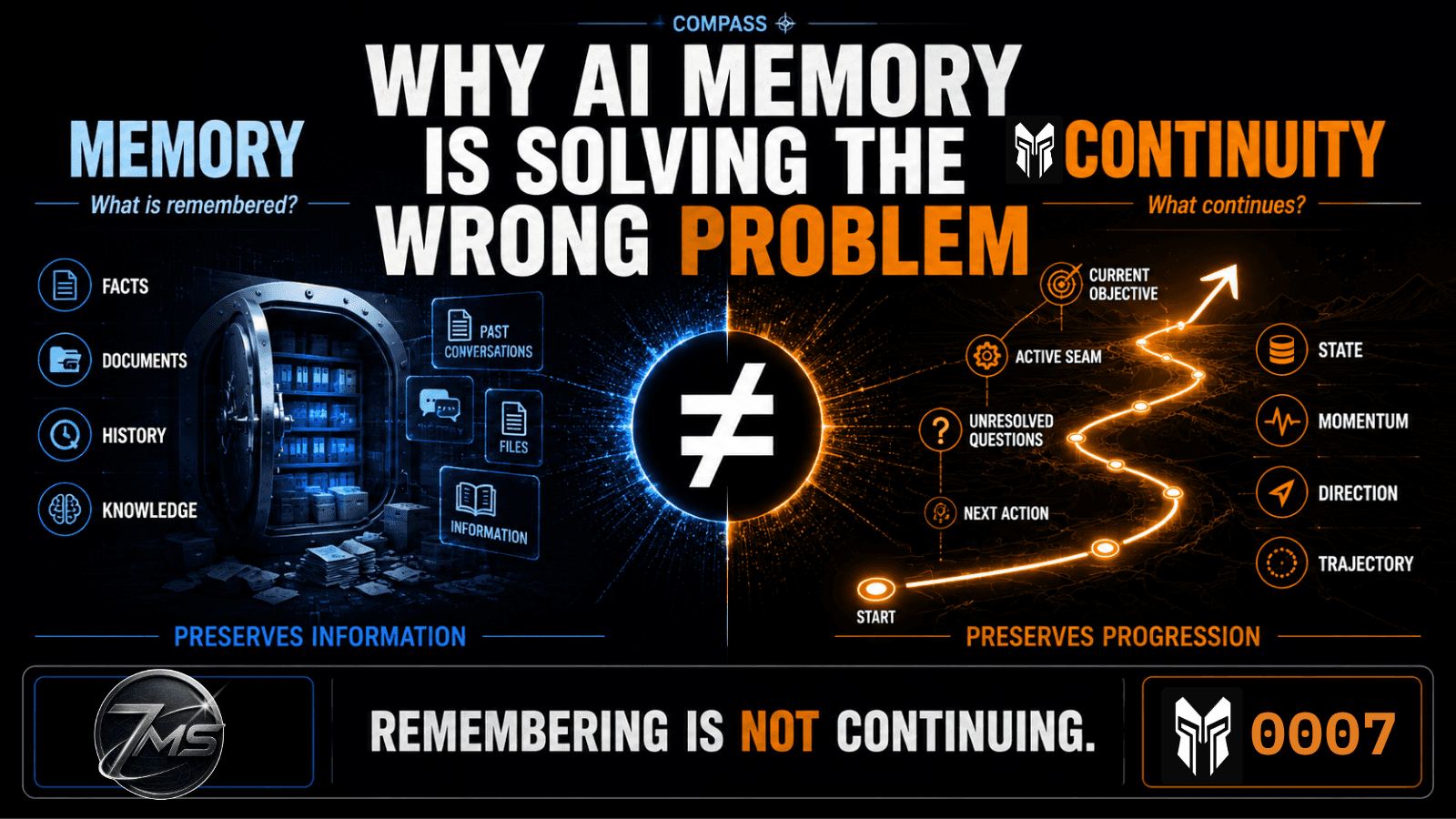
Because remembering information is not the same thing as continuing a process.
A model can know many things.
It can know:
facts
decisions
documents
plans
Yet still lose the thread.
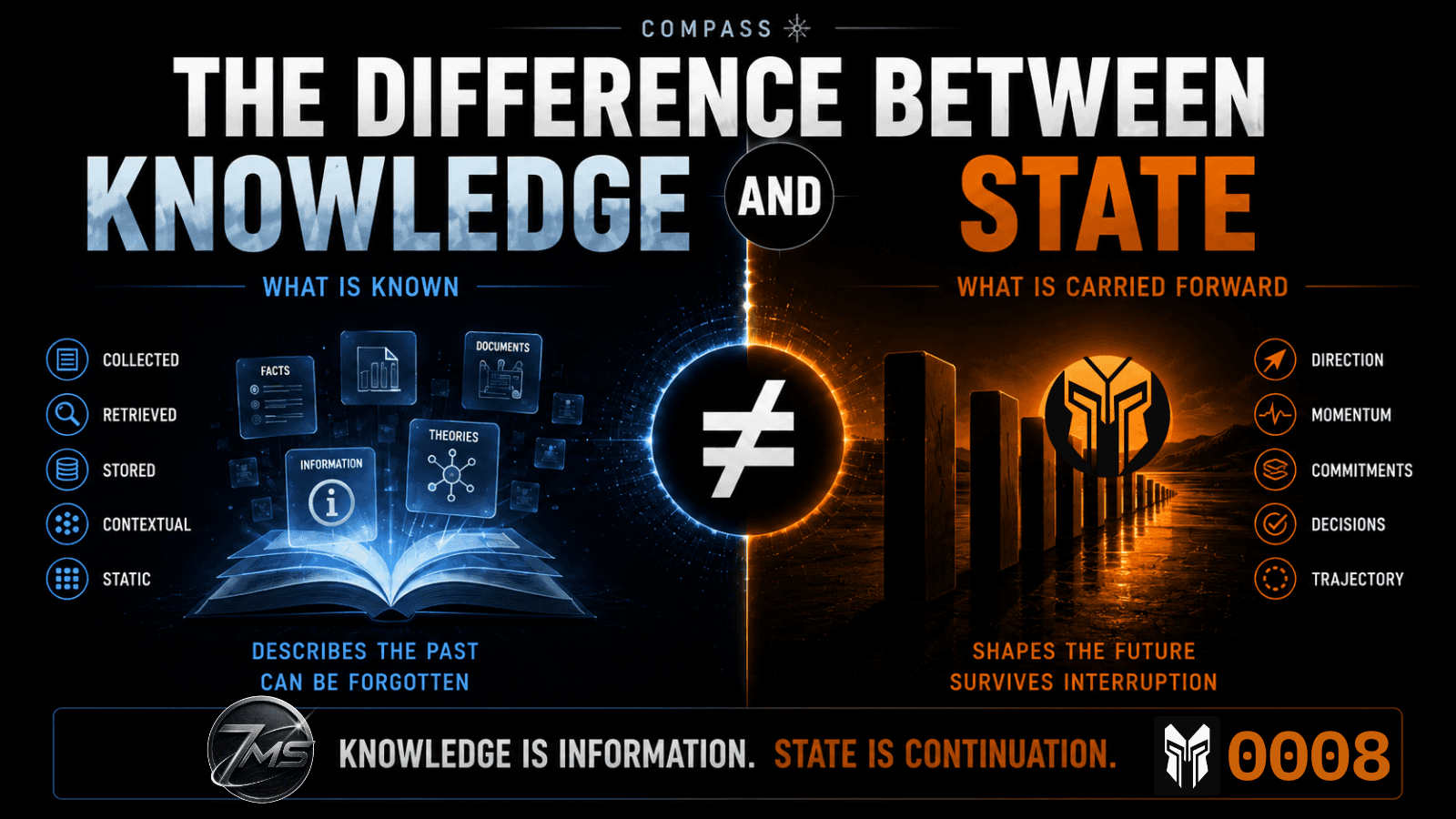
The missing element is not knowledge.
The missing element is state.
Knowledge answers:
What is true?
State answers:
What is happening?
Continuity depends on state.
Not merely knowledge.
Imagine reading a book.
A memory system stores every page.
A continuity system preserves your place in the story.
These are different capabilities.
One preserves information.
The other preserves progression.
Reasoning behaves much more like progression than storage.
From a continuity perspective, the important question changes.
Instead of asking:
How can the system remember more?
We ask:
How can the reasoning process continue?
This shifts the focus away from archives and toward state.
Away from storage and toward continuity.
Away from remembering and toward resuming.
A larger context window can delay continuity failure.
It cannot eliminate it.
A million tokens still represent stored information.
They do not automatically preserve the conditions required for a reasoning process to continue coherently.
Storage helps.
Continuity requires something more.
If memory is not the fundamental problem, then what is?
A different question begins to emerge:
What is the minimum state required to allow reasoning to continue across time?
This question leads toward continuity systems.
Not memory systems.
The future of AI may not be defined by who remembers the most.
It may be defined by who preserves continuity most effectively.
The distinction is subtle.
But it changes everything.
One path produces larger archives.
The other path produces persistent reasoning.
Memex does not begin with memory.
It begins with continuity.
Memory may be one ingredient.
But continuity is the goal.
The challenge is not preserving the past.
The challenge is preserving enough state that the future can continue from where it left off.
That is a different problem.
And it may be the more important one.
Temporal Continuity
Previous Snapshot
Related Seam
Related Compass
• The Real Problem Isn't AI Memory — It's Continuity Collapse
• Why GPT Forgets Long Projects
Related Doctrine
• Continuity Is a Runtime Problem