The AI Retrieval Problem Isn't Actually a Retrieval Problem
A few days ago I came across a Reddit discussion that felt familiar.
The author described a problem many AI users are starting to encounter.
Not bad outputs.
Not weak reasoning.
Not poor prompts.
The opposite.
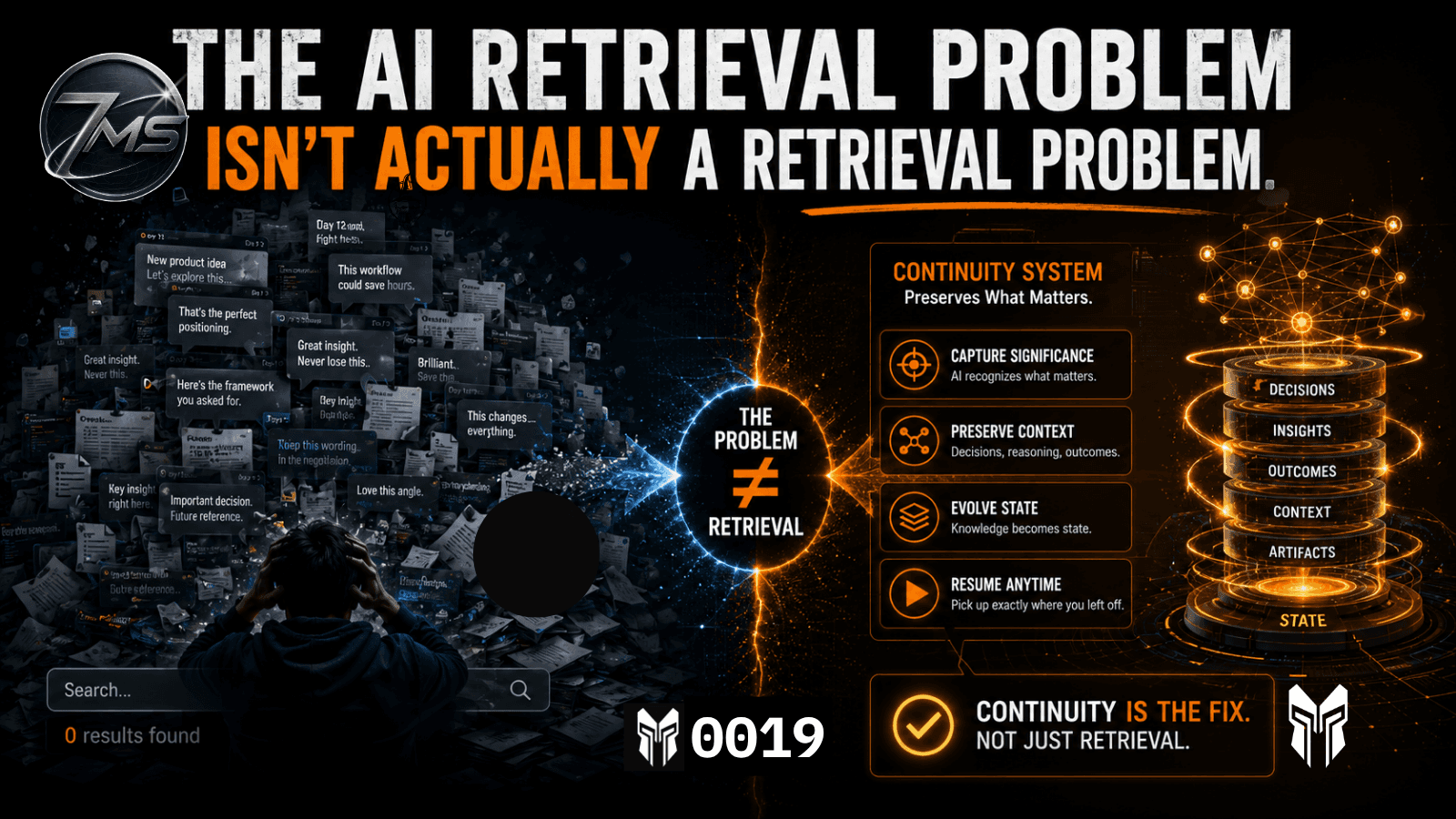
The AI had become so useful that valuable ideas were now being lost inside the volume of conversations being generated.
Product ideas.
Workflows.
Strategies.
Negotiation language.
Insights.
Frameworks.
Useful things.
The author described the experience perfectly.
You remember the insight.
You remember why it mattered.
You almost remember how it was phrased.
But finding the exact response again feels impossible.
The comments immediately filled with solutions.
Export everything.
Save markdown files.
Build a second brain.
Create codewords.
Copy useful paragraphs into notes.
Create breakthrough repositories.
Build memory layers.
Construct knowledge bases.
Everyone agreed there was a retrieval problem.
I don't think there is.
At least not in the way people think.
The Hidden Pattern
Every proposed solution follows the same workflow.
The user discovers value.
The user recognizes value.
The user extracts value.
The user stores value.
The user retrieves value.
The AI participates in none of it.
This is the strange part.
The AI generated the insight.
The AI was present during the decision.
The AI understands the surrounding context.
The AI knows what came before and after.
Yet preservation remains entirely a human responsibility.
Every workaround in the thread was effectively a manual preservation system.
Different tools.
Same pattern.
Export Everything
Many people suggested exporting their entire ChatGPT history and searching through it later.
This works surprisingly well.
Nothing gets lost.
Everything becomes searchable.
The downside is obvious.
The user still has to remember what they're looking for.
The user still performs the retrieval.
The user still acts as the continuity layer.
The transcript becomes an archive.
Save Markdown Files
Others save useful outputs into markdown files.
Again, this works.
Files are durable.
Files are portable.
Files are searchable.
But all we've really done is move information from one pile into another pile.
The burden remains unchanged.
The user decides what matters.
The user extracts it.
The user organizes it.
Build a Second Brain
Obsidian, NotebookLM, personal knowledge systems, vaults.
These are increasingly common.
They're powerful.
They're useful.
They also create an interesting side effect.
The AI conversation becomes separate from the knowledge system.
One generates.
The other stores.
The human acts as the bridge.
Create Codewords
One commenter had a clever idea.
Whenever something valuable appeared, they would create a unique keyword.
A retrieval token.
Three days later they could search the token and immediately find the insight.
Brilliant.
Also revealing.
What they built was essentially a manual database index.
Again, the user becomes responsible for preservation.
Create Breakthrough Repositories
Another user described maintaining collections of important discoveries.
Useful outputs get promoted out of the conversation and into permanent storage.
This may be the most common pattern emerging among power users.
The AI creates insights.
Humans curate them.
Humans become librarians.
Memory Layers
Many commenters pointed toward memory systems.
Persistent memory.
Retrieval systems.
Knowledge layers.
These are closer to the actual problem.
But most memory systems still focus on recall.
They remember facts.
They retrieve snippets.
They surface information.
The question remains:
Do they preserve continuity?
The Comment Everyone Accepted
One comment stood out.
The chat log is a transcript, not a knowledge base.
Everyone immediately agreed.
I didn't.
In fact, I think that assumption deserves scrutiny.
Why should a transcript remain a transcript?
Why can't a transcript evolve?
Why can't decisions become artifacts?
Why can't artifacts become state?
Why can't state become resumable?
The assumption that conversations are disposable transcripts may be the thing holding AI systems back.
Retrieval Is The Symptom
Most people describe the problem like this:
"I know the insight exists. I just can't find it."
That sounds like retrieval.
But look deeper.
The real frustration isn't finding information.
The frustration is losing continuity.
Humans don't remember transcripts.
Humans compress.
We remember decisions.
We remember outcomes.
We remember commitments.
We remember patterns.
We remember significance.
Nature doesn't preserve everything.
Nature preserves what matters.
The Shift Nobody Is Talking About
For years the AI conversation focused on generation.
Better prompts.
Better models.
Better outputs.
That was the bottleneck.
Today something has changed.
Generation quality is increasingly good enough.
The bottleneck is shifting.
Not from generation to retrieval.
From generation to continuity.
Users are no longer asking:
"How do I get a good answer?"
They're asking:
"How do I preserve the value of the answers I already have?"
That's a fundamentally different problem.
The Missing Piece: State
Most retrieval systems assume the thing you're looking for is information.
A paragraph.
A note.
A decision.
A useful piece of text.
But information is only part of the problem.
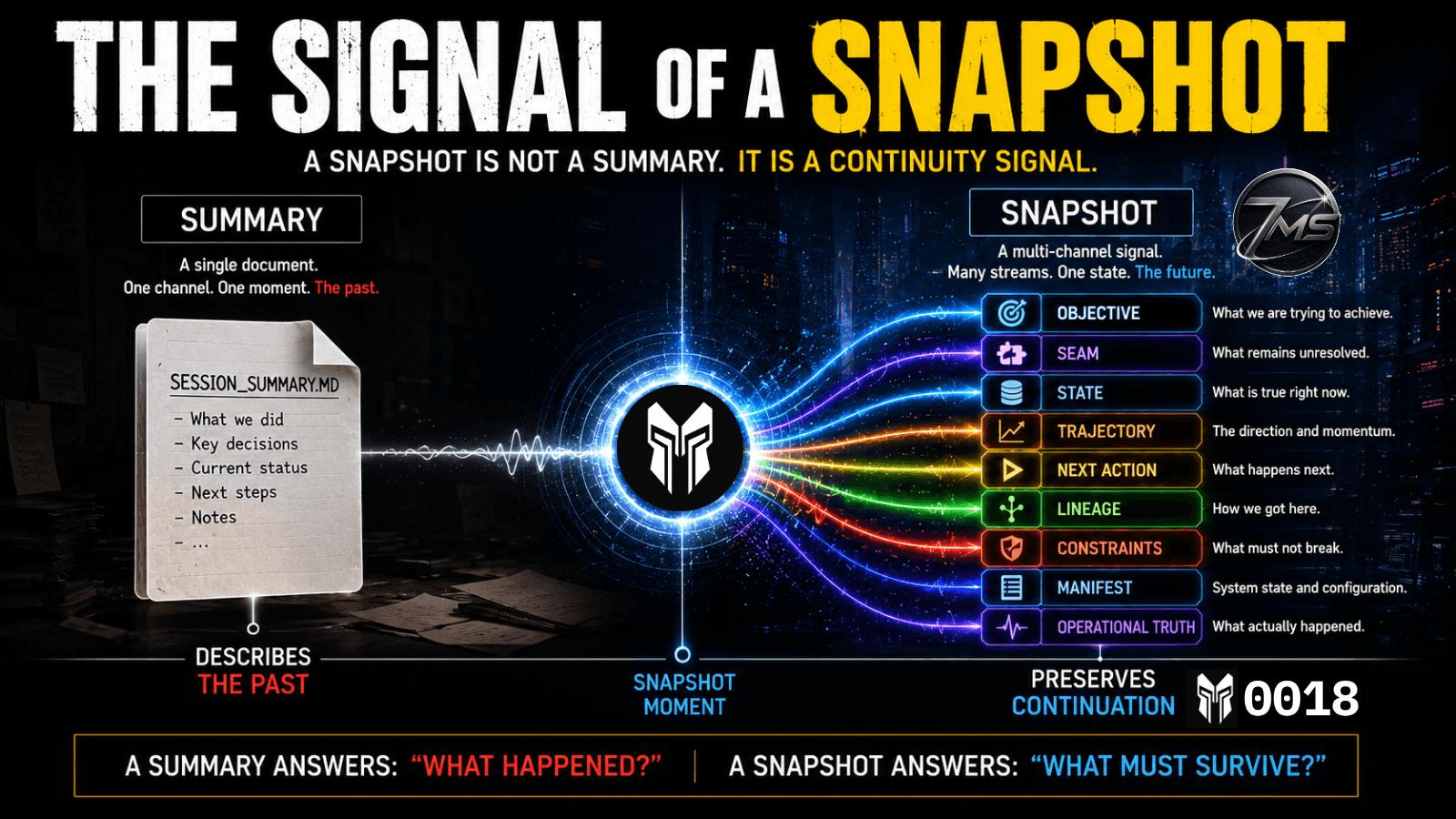
The deeper problem is state.
State is everything that exists because of the information.
The decisions that were made.
The assumptions that were accepted.
The direction the work was moving.
The commitments that were created.
The unresolved questions that remained.
The trajectory that emerged.
Retrieval can recover information.
It cannot automatically recover state.
This is why finding the paragraph often isn't enough.
You find the insight.
But then you need to remember why it mattered.
What decision it influenced.
What came before it.
What happened after it.
Whether it was later replaced.
Whether it is still true.
The information survived.
The state did not.
That distinction matters because information can be retrieved.
State must be preserved.
The Memex View
From the perspective of continuity systems, retrieval is the wrong abstraction.
The valuable thing isn't the paragraph.
The valuable thing is understanding:
Why it mattered.
What decision it influenced.
What depended on it.
Whether it was superseded.
Whether it should be restored today.
That's not retrieval.
That's lineage.
That's state.
That's continuity.
Closing
People think they have a retrieval problem because retrieval is the symptom they can feel.
But the solutions they're building tell a different story.
They're not searching for information.
They're trying to preserve continuity.
And those are not the same thing.
The next generation of AI systems will not be defined by intelligence alone.
They will be defined by continuity.
Because eventually every useful AI system encounters the same question:
What happens to the work after the conversation ends?
Today, humans answer that question manually.
Tomorrow, the systems themselves will need to answer it.
That's not a retrieval problem.
It's a continuity problem.
Previous Snapshot
• Somehow We Built Frontier AI And Got Pac-Man
Related Seam
• What Is Continuity Engineering?
Related Compass
• What Is Reasoning State?
• What Is AI Continuity?
Related Doctrine
• What Is Memex?
• Continuity Is a Runtime Problem
• The River and the Gong