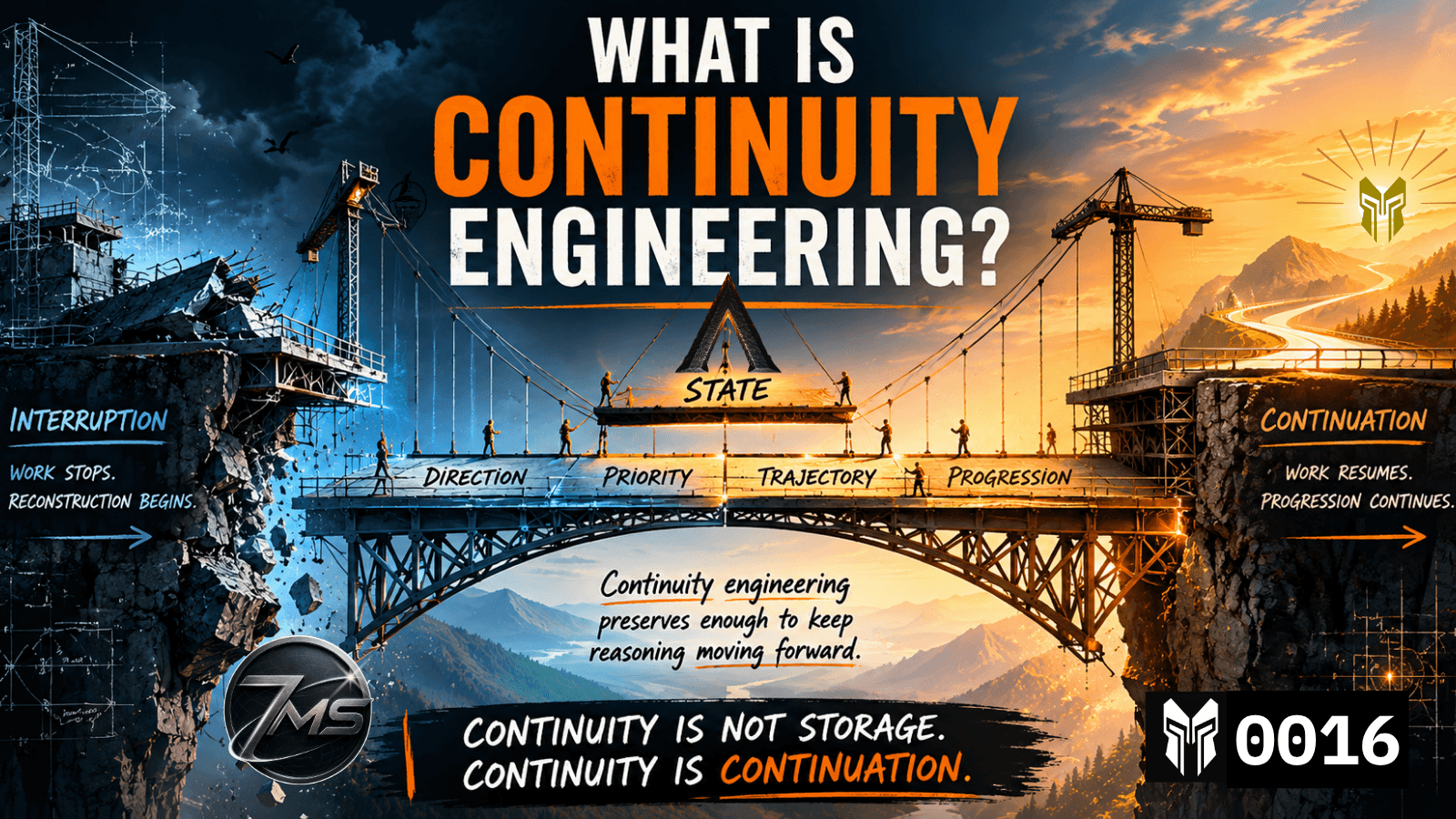
What Is Continuity Engineering?
Engineering disciplines are often defined by the problems they solve.
Database engineering solves persistence.
Network engineering solves communication.
Security engineering solves trust.
As AI systems become increasingly capable, another problem is beginning to emerge.
Continuation.
Not memory.
Not retrieval.
Not context.
Continuation.
The Reconstruction Problem
Long-running work frequently experiences interruption.
Sessions end.
Contexts disappear.
Models change.
Projects pause.
When work resumes, a familiar process begins.
Reconstruction.
The system must determine:
What was happening?
What remained unresolved?
What direction mattered?
What should happen next?
The information may still exist.
The continuity often does not.
Existing Solutions
Several disciplines already address related problems.
Memory systems preserve information.
Retrieval systems recover information.
Context engineering improves information availability.
All of these are valuable.
Yet they primarily answer the same question:
What should the system know?
Continuity introduces a different question.
What must survive so the process can continue?
Information And Continuation
A system may possess perfect memory.
Every document is preserved.
Every conversation is searchable.
Every decision is recorded.
Yet continuity can still collapse.
Why?
Because continuation depends on more than information.
It depends on preserving the active conditions under which reasoning was unfolding.
The information survives.
The progression does not.
The State Layer
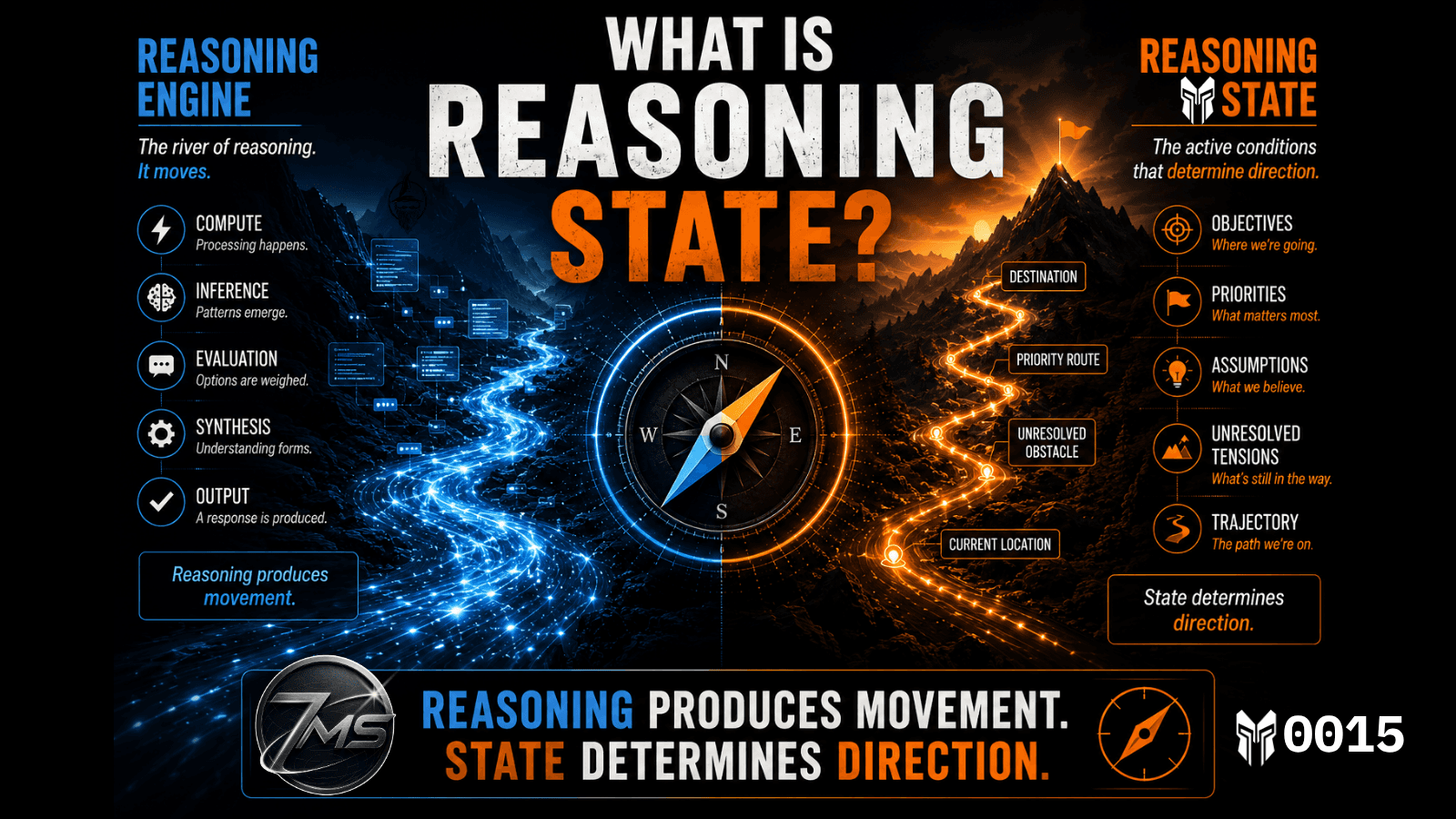
Continuation requires state.
State may include:
objectives
assumptions
priorities
tensions
trajectory
momentum
These elements allow work to continue without repeatedly rediscovering itself.
Without state, reconstruction becomes necessary.
With state, continuation becomes possible.
What Continuity Engineering Optimizes
If memory engineering optimizes remembrance, continuity engineering optimizes continuation.
Its purpose is not to preserve everything.
Its purpose is to preserve enough.
Enough state.
Enough direction.
Enough trajectory.
Enough progression.
So the process can continue across interruption.
Why The Discipline Matters
As AI systems move beyond isolated interactions, continuity becomes increasingly important.
Projects become longer.
Reasoning becomes more persistent.
Work becomes increasingly distributed across sessions, tools, and models.
The cost of reconstruction grows.
The value of continuation grows with it.
A Different Focus
Context engineering asks:
What should the model understand?
Continuity engineering asks:
What must survive?
Memory engineering asks:
What should be remembered?
Continuity engineering asks:
What should continue?
The distinction is subtle.
But it changes how long-running systems are designed.
The Compass Perspective
Memory preserves information.
Context improves awareness.
Continuity preserves progression.
Continuity engineering is the discipline concerned with making that progression survive across time.
Not by preserving everything.
But by preserving enough for the work to continue.
Previous Snapshot
• What Is Reasoning State?
Related Seam
• Why Context Engineering Is Not Continuity Engineering
Related Compass
• What Is AI Continuity?
• Why AI Memory Is Solving The Wrong Problem
Related Doctrine
• What Is Memex?
• Continuity Is a Runtime Problem
• The River and the Gong