Somehow We Built Frontier AI And Got Pac-Man
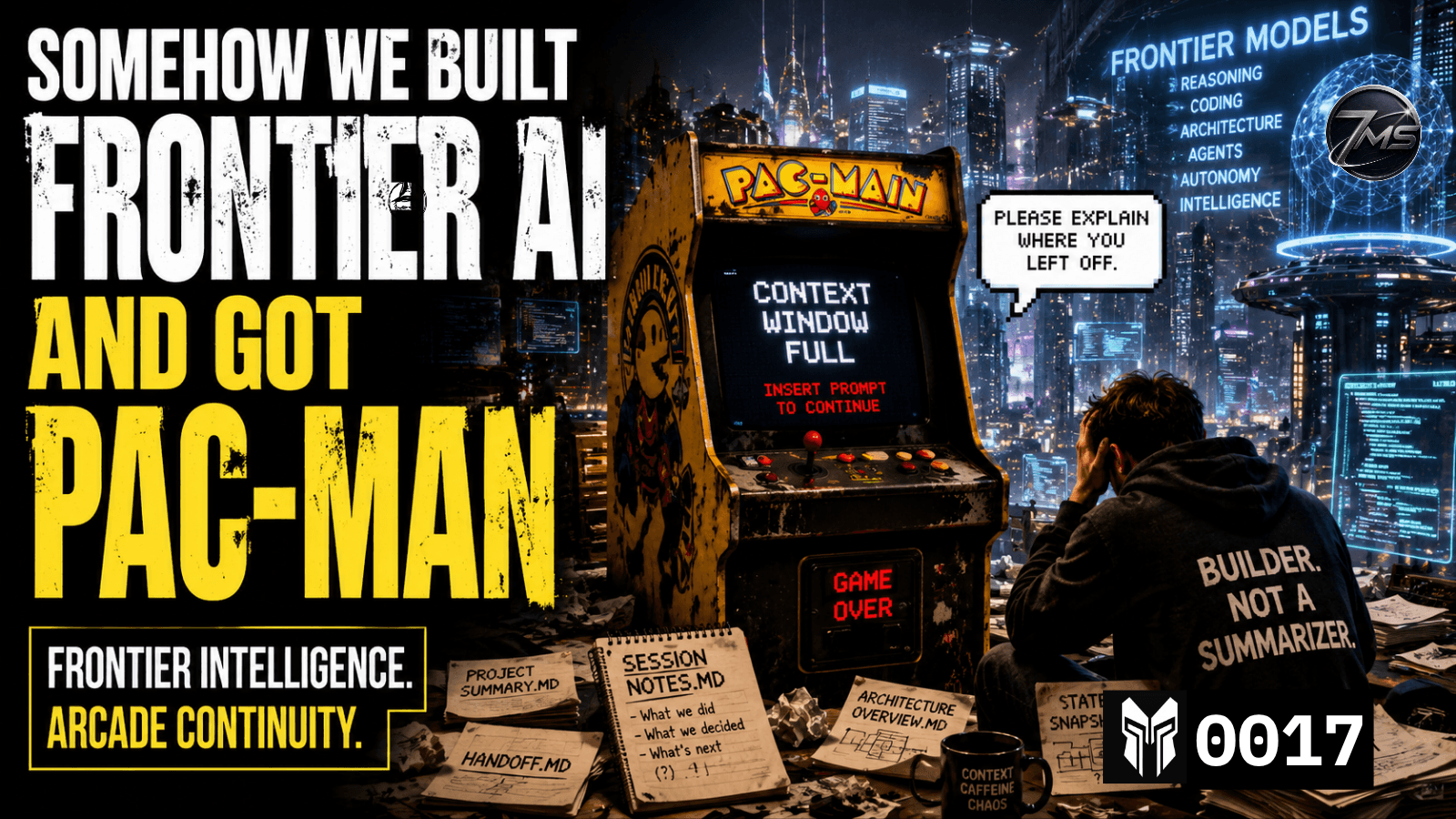
Somehow we built frontier AI and got Pac-Man.
The models can write software.
They can analyze repositories.
They can design systems.
They can generate architecture.
They can help build companies.
Yet every time the context window fills up, the game ends.
New session.
New explanation.
New reconstruction.
New confidence-building exercise.
And somehow we've convinced ourselves this is normal.
Imagine A Modern Game
Imagine spending two hundred hours playing a massive RPG.
You build your character.
Unlock skills.
Complete quests.
Discover hidden paths.
Develop strategies.
You reach a checkpoint.
Save the game.
Turn off the console.
The next day you return.
Instead of loading your progress, the game asks:
"Can you explain where you left off?"
You write a summary.
The game asks:
"What quests were active?"
You write another summary.
The game asks:
"What were you planning to do next?"
You write another summary.
Twenty minutes later, the game reconstructs an approximation of your progress and allows you to continue.
Nobody would tolerate this.
Yet this is how AI development works.
The Reconstruction Loop
Every serious AI builder knows the routine.
Build momentum.
Fill the context window.
Export notes.
Start a new chat.
Upload notes.
Explain the architecture.
Explain the project.
Explain the current state.
Explain the next steps.
Wait for confidence to rebuild.
Continue working.
Then repeat the process again later that day.
And again tomorrow.
And again next week.
The industry has normalized reconstruction.
The Professional Workarounds
Experienced builders know this is a problem.
So they build rituals around it.
Project primers.
Seed files.
Startup prompts.
Templates.
Operating instructions.
Carefully crafted onboarding sequences.
These systems help.
But they all reveal the same thing.
Builders are manually constructing continuity infrastructure.
Because continuity does not exist by default.
The Markdown Illusion
Most builders eventually arrive at the same solution.
At the end of a session they ask:
"Create a markdown summary."
The model generates:
project_summary.md
handoff.md
session_notes.md
architecture_overview.md
state_snapshot.md
The names change.
The structures change.
The formats change.
The files appear useful.
And often they are.
Until the next session.
Then the model creates a different structure.
A different interpretation.
A different path.
Soon the project contains multiple summaries describing multiple realities.
The notes survived.
The continuity did not.
The Hidden Cost
The obvious cost is time.
Twenty minutes here.
Thirty minutes there.
Hours each week.
But the larger cost is something else.
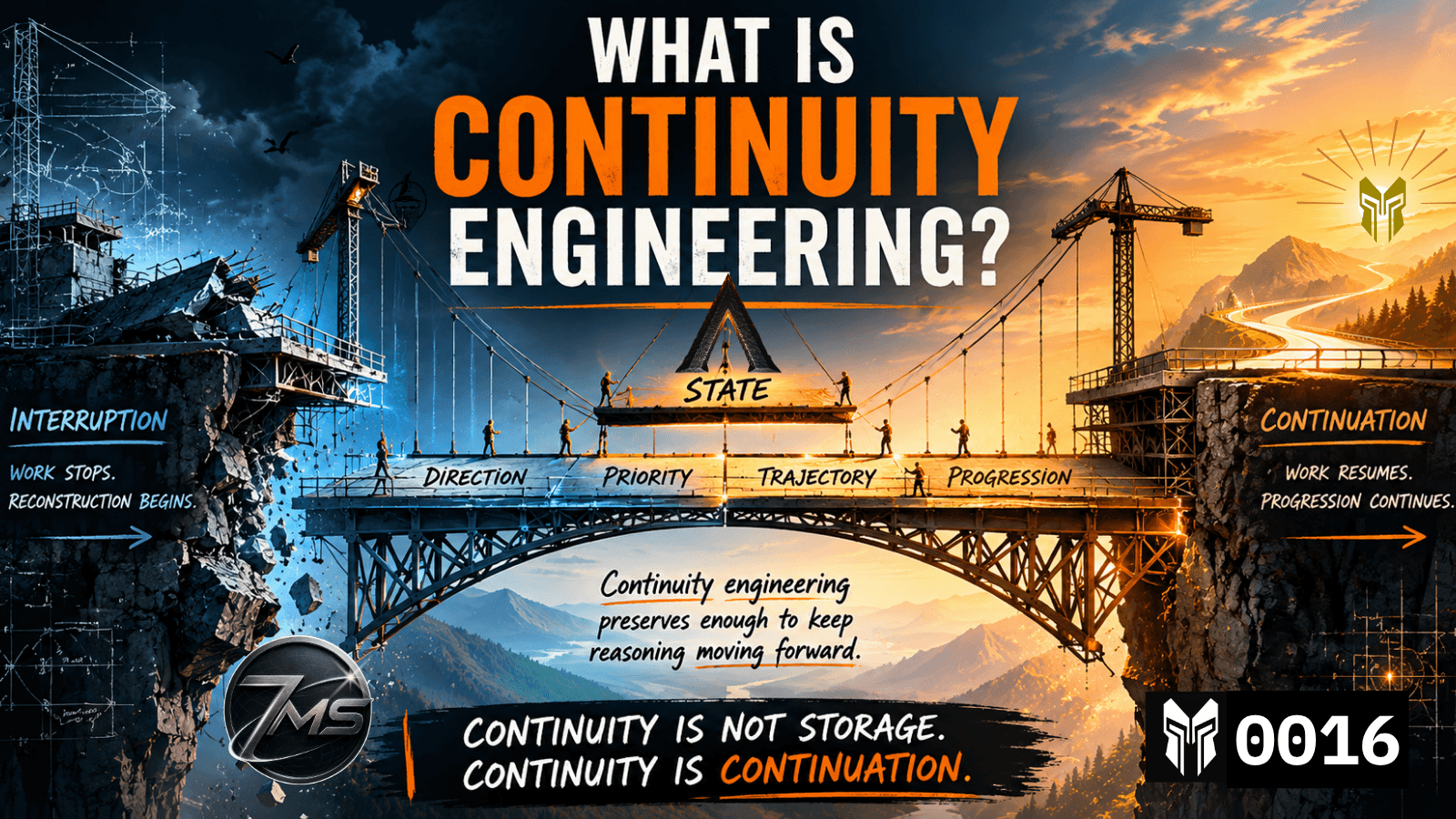
Trajectory.
Projects do not usually fail because information disappears.
Projects fail because direction disappears.
The system loses:
What mattered most.
What remained unresolved.
What assumptions were active.
What path was being pursued.
The documents survive.
The trajectory does not.
The Industry's Mental Model
The industry largely treats continuity as a documentation problem.
A better summary.
A better handoff.
A better note.
A better prompt.
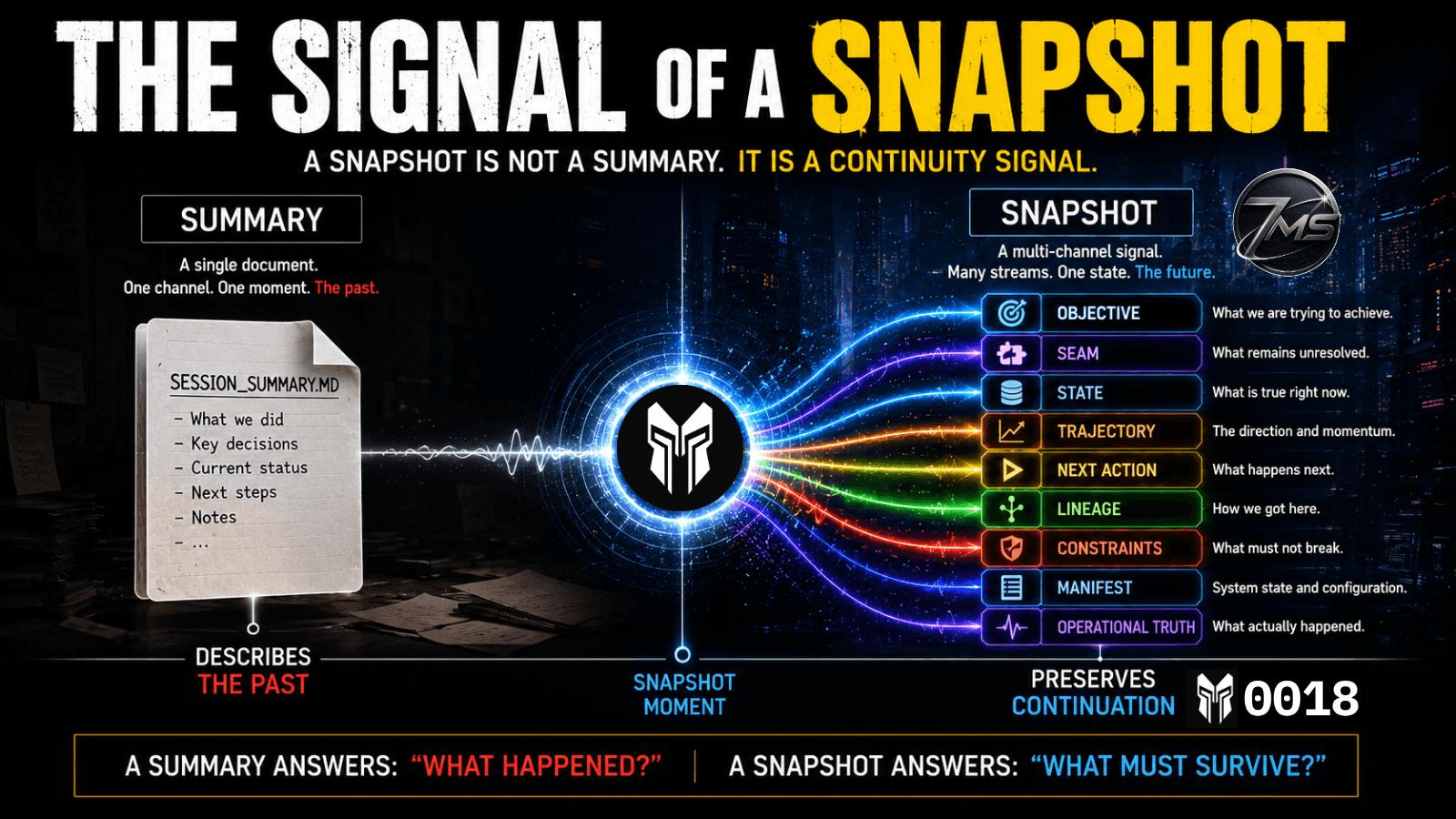
But save games are not notes.
A checkpoint is not documentation.
A continuation system is not a handoff document.
These things solve different problems.
One preserves information.
The other preserves progression.
What Changes
A save game does not explain the game.
It preserves the state of the game.
The distinction matters.
When continuity exists, the goal is no longer:
"How do I rebuild context?"
The goal becomes:
"Where do I want to continue?"
That shift changes everything.
The session stops being the unit of work.
Progress becomes the unit of work.
Prime. Snapshot. Resume.
A builder reaches a clean stopping point.
Prime.
Snapshot.
Resume.
The objective survives.
The state survives.
The trajectory survives.
The work continues.
Not because the model became more intelligent.
Because continuity survived the interruption.
Why This Matters
The AI industry has spent years improving intelligence.
Models became faster.
Smarter.
More capable.
More useful.
Yet continuity remains surprisingly primitive.
We built frontier intelligence.
We forgot save games.
And until continuity becomes a first-class part of AI work, builders will continue spending time reconstructing progress they already earned.
The Compass Perspective
The industry has normalized reconstruction.
Continuity begins when reconstruction is no longer required.
Frontier intelligence deserves more than arcade continuity.
Previous Snapshot
• What Is Continuity Engineering?
Related Seam
• Why Context Engineering Is Not Continuity Engineering
Related Compass
• What Is AI Continuity?
• What Is Reasoning State?
• Why AI Memory Is Solving The Wrong Problem
Related Doctrine
• What Is Memex?
• Continuity Is a Runtime Problem
• The River and the Gong