

Why Context Engineering Is Not Continuity Engineering
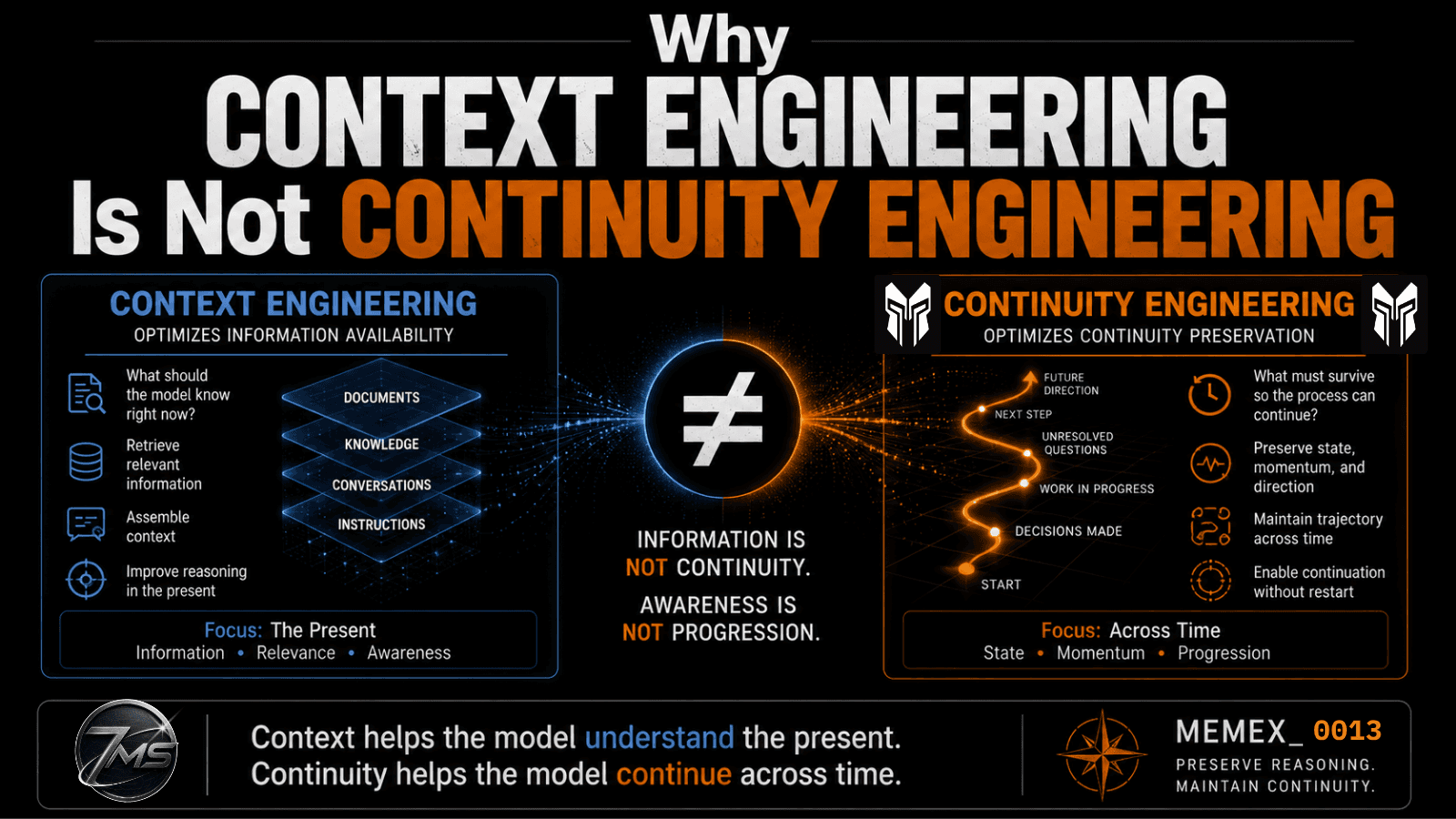
Context engineering helps AI systems understand the present. Continuity engineering helps them continue across time. They are related, but they solve fundamentally different problems.
by
Context engineering has become one of the most important ideas in modern AI.
As models become more capable, attention increasingly shifts toward a different question:
How do we provide the right context at the right time?
The answer has produced an entire discipline.
Context engineering.
Retrieval systems.
Context windows.
Prompt assembly.
Knowledge injection.
Dynamic context selection.
All designed to help a model understand the situation it is currently operating within.
This is valuable work.
But it quietly assumes something important.
It assumes context and continuity are the same problem.
They are not.
Context engineering answers a practical question:
What should the model know right now?
This is fundamentally an information problem.
The goal is to ensure that relevant information remains available during reasoning.
Examples include:
project documents
technical references
previous conversations
retrieved knowledge
active instructions
Without context, reasoning quality suffers.
The model becomes blind to important information.
Context engineering exists to solve that problem.
Because context engineering improves performance, it is tempting to believe it also improves continuity.
The logic seems straightforward.
Better context should create better continuity.
Yet long-running projects continue to experience familiar problems:
repeated onboarding
repeated explanations
repeated decisions
repeated reconstruction
The information exists.
The continuity still collapses.
Imagine a map.
The map tells you:
where you are
what surrounds you
what paths exist
The map is useful.
But it does not tell you:
where you were heading
what remains unfinished
why you chose a particular route
what tension still exists
The map provides context.
It does not preserve trajectory.
Context is primarily concerned with the present.
Continuity is concerned with time.
Context answers:
What is relevant right now?
Continuity answers:
What was happening across time?
These are different dimensions.
One focuses on information.
The other focuses on progression.
This distinction becomes obvious during long-running work.
A project may have perfect context.
Every file is available.
Every document is searchable.
Every decision is preserved.
Yet continuity can still weaken.
Why?
Because continuity depends on more than information.
It depends on:
momentum
direction
unresolved boundaries
active state
trajectory
These are not automatically preserved through context alone.
One of the strengths of context engineering is that context can often be reconstructed.
Documents can be retrieved.
References can be recovered.
Knowledge can be assembled.
Continuity is different.
Once continuity collapses, reconstruction becomes expensive.
The work must be rediscovered.
The direction must be re-established.
The momentum must be rebuilt.
As AI systems mature, context engineering will become increasingly sophisticated.
But there may be another layer emerging above it.
A layer concerned not with:
What should the model know?
but with:
What must survive so the process can continue?
That is a different problem.
And it suggests a different discipline.
If context engineering optimizes information availability, continuity engineering would optimize continuity preservation.
Not storage.
Not retrieval.
Not context assembly.
Continuity.
The preservation of enough state that a reasoning process can continue across time without repeatedly reconstructing itself.
The future of AI will likely require both.
Context engineering improves reasoning quality.
Continuity engineering preserves reasoning progression.
Neither replaces the other.
Both solve important problems.
But they should not be confused.
A system can have excellent context and poor continuity.
Understanding that distinction may become increasingly important as AI systems move from isolated interactions toward long-running work.
Context engineering helps a system understand the present.
Continuity engineering helps a system continue across time.
The distinction is subtle.
But it changes how long-running reasoning systems are understood.
One focuses on information.
The other focuses on progression.
One optimizes awareness.
The other optimizes continuation.
And as AI systems become more persistent, the difference between the two may matter more than ever.
Previous Snapshot
• The Hidden Cost of AI Context Switching
Related Seam
Related Compass
• Why RAG Doesn't Solve Continuity
Related Doctrine
• Continuity Is a Runtime Problem