

The Hidden Cost of AI Context Switching
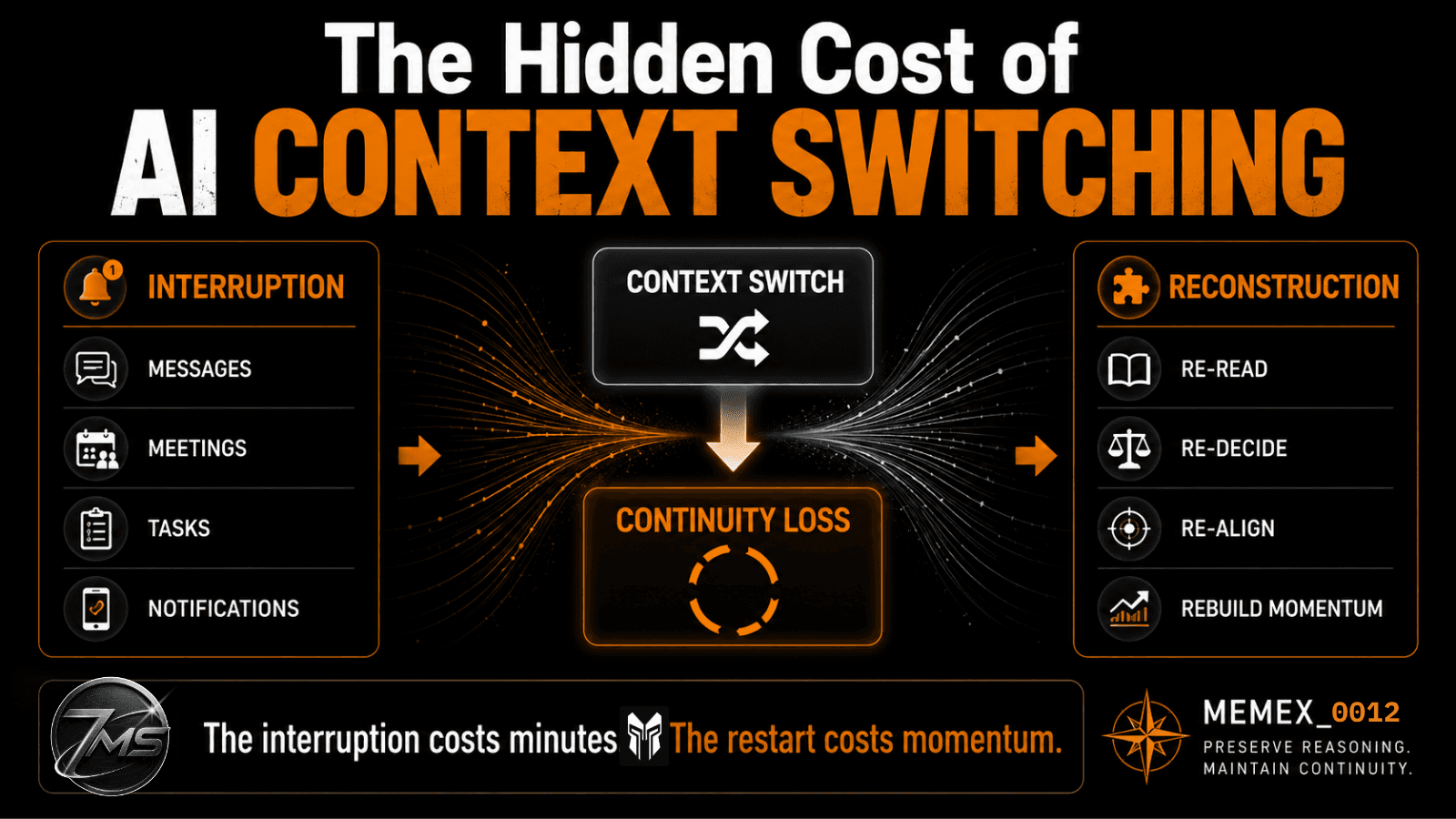
Most people think context switching costs time. The deeper cost is continuity. Every interruption forces a reasoning process to reconstruct the state that was lost.
by
Everyone understands context switching.
You are working on one task.
Something interrupts you.
A message arrives.
A meeting begins.
A different project demands attention.
You switch.
When you eventually return, productivity drops.
Focus takes time to recover.
This phenomenon is well understood.
What is less understood is the real cost.
Most people assume context switching costs time.
The deeper cost is continuity.
Traditional productivity discussions describe context switching as an efficiency problem.
The interruption creates friction.
Work slows down.
Attention becomes fragmented.
Performance decreases.
All of this is true.
But it is not the whole story.
When work is interrupted, information rarely disappears.
The files still exist.
The documents remain available.
The project has not been erased.
Yet something important has been lost.
The active state of the work begins to decay.
Questions that felt obvious become unclear.
Momentum weakens.
Direction becomes less certain.
The work still exists.
The continuity does not.
Every interruption creates hidden work.
When returning to a project, people often spend time:
re-reading documents
revisiting decisions
reconstructing assumptions
rediscovering priorities
recovering momentum
This effort rarely appears on schedules.
Yet it occurs constantly.
The interruption itself may have lasted ten minutes.
The recovery may take an hour.
This is what makes context switching deceptive.
The information remains accessible.
Everything appears intact.
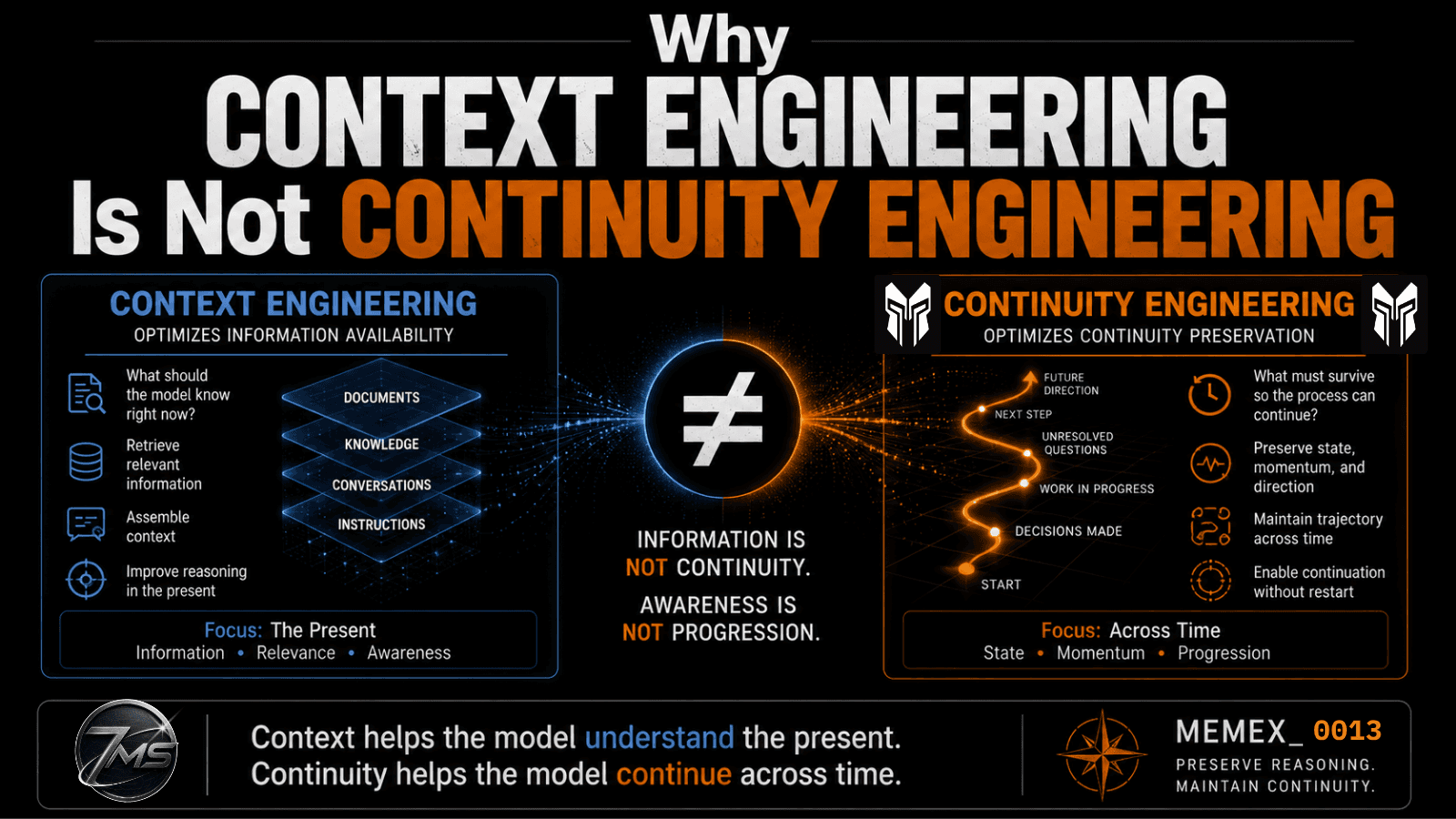
But accessibility is not continuity.
A project can remain fully documented while simultaneously losing momentum.
The files survive.
The trajectory weakens.
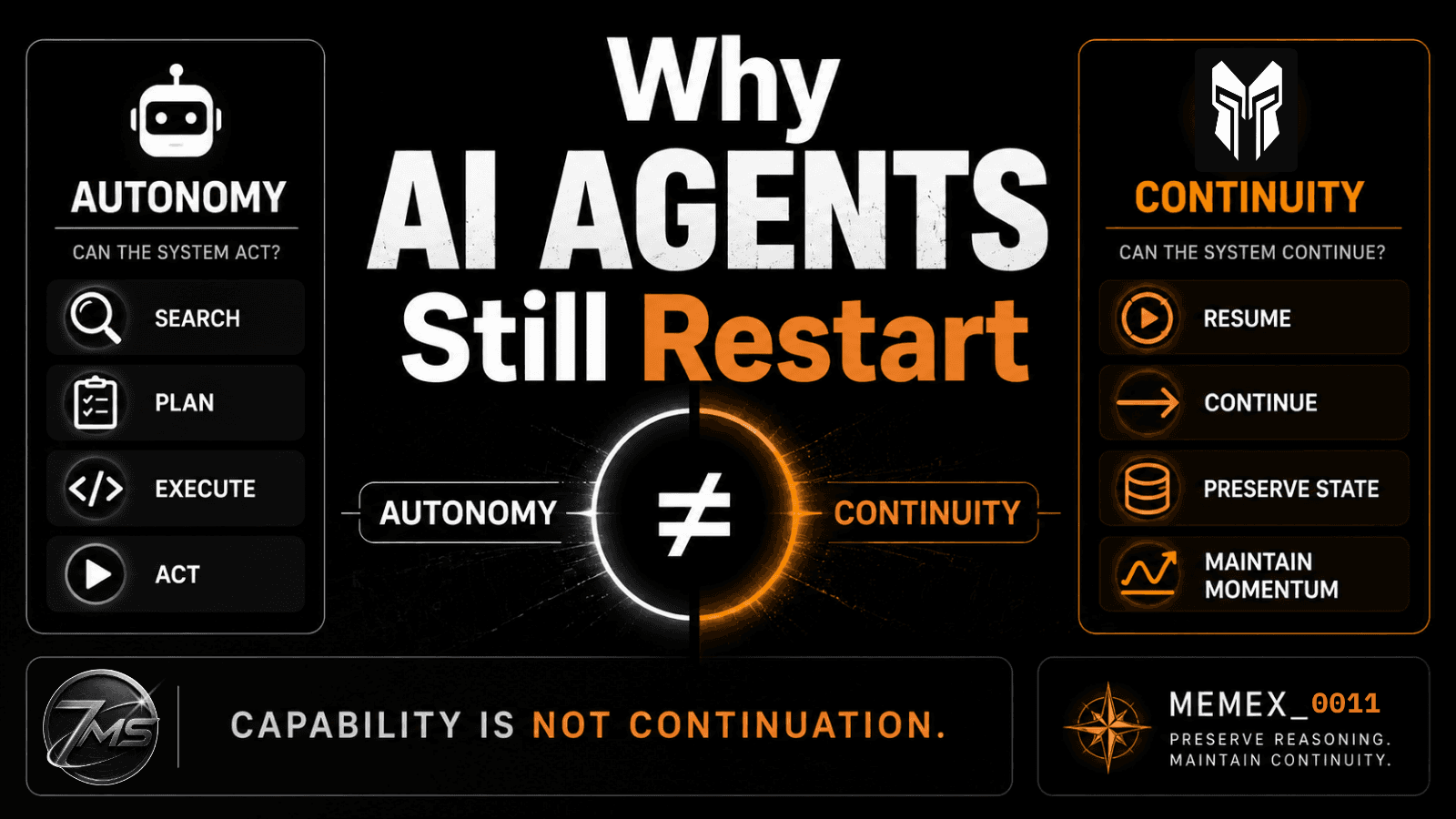
AI systems often encounter a similar challenge.
Information can remain available through:
context windows
retrieval systems
documents
conversation history
Yet continuity still breaks.
Why?
Because the challenge is not always access to information.
The challenge is preserving the active state of a process.
Every context switch introduces a restart tax.
The system must reconstruct:
where work stopped
what remains unresolved
which decisions matter
what should happen next
The larger the project becomes, the more expensive this reconstruction becomes.
Over time, the hidden tax compounds.
Momentum is often treated as a psychological phenomenon.
But momentum also contains information.
It represents:
direction
pressure
progression
active boundaries
Momentum tells a system where movement is occurring.
When momentum disappears, continuity weakens.
Instead of asking:
How much time does context switching cost?
We might ask:
How much continuity does context switching destroy?
This question changes the focus entirely.
The issue is no longer efficiency.
The issue becomes continuity preservation.
As projects become longer and more complex, continuity becomes increasingly valuable.
The challenge is not merely storing information.
The challenge is preserving enough state that work can continue without repeated reconstruction.
The less reconstruction required, the more continuity survives.
Most discussions about context switching focus on productivity.
A continuity perspective focuses on something deeper.
The hidden cost is not the interruption itself.
The hidden cost is the collapse of continuity that follows.
Every restart forces a system to rebuild what was already understood.
The future of long-running AI work may depend less on reducing interruptions and more on preserving continuity when interruptions inevitably occur.
That distinction changes how the problem is understood.
And it changes what solutions become possible.
Previous Snapshot
Related Seam
Related Compass
• Why GPT Forgets Long Projects
• Why Context Windows Will Never Solve Continuity
Related Doctrine
• Continuity Is a Runtime Problem