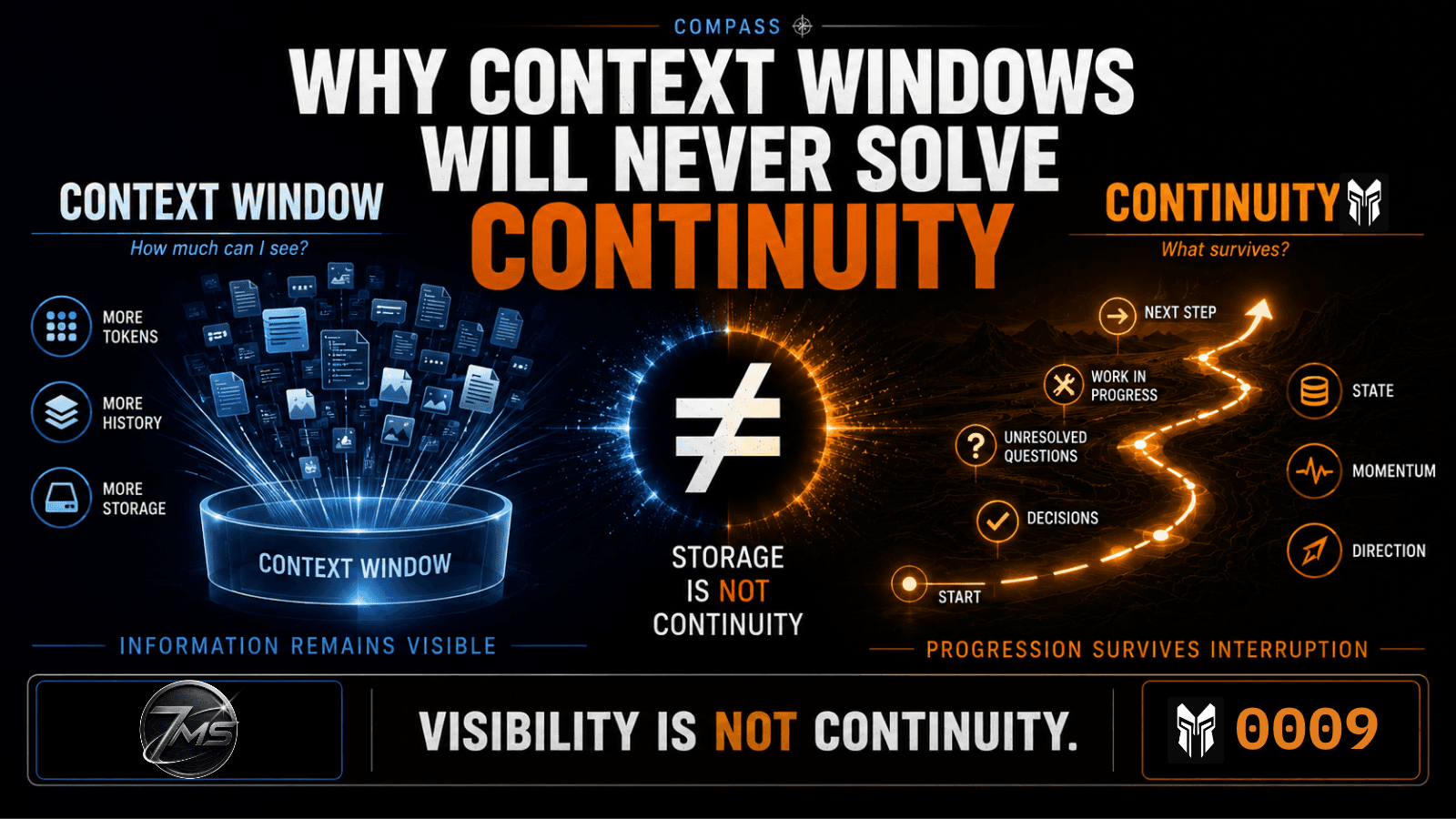
Why Context Windows Will Never Solve Continuity
As AI systems improve, one solution appears again and again:
Make the context window larger.
The reasoning seems straightforward.
If models forget because context disappears, then increasing context should improve continuity.
A larger context window allows more information to remain visible.
More information should produce better continuity.
At first glance, this seems correct.
But it confuses two different problems.
The Storage Assumption
Context windows are fundamentally storage systems.
They determine how much information can remain visible to a model at a given moment.
A larger window means:
more conversation history
more documents
more code
more instructions
more visible information
This is valuable.
But visibility is not continuity.
The Library Problem
Imagine a library.
A small library contains one shelf.
A large library contains ten thousand shelves.
The larger library clearly stores more information.
But neither library knows:
what problem is currently being solved
what remains unresolved
where work stopped
what should happen next
Storage increased.
Continuity did not.
Bigger Windows Delay Failure
A larger context window can absolutely help.
Information survives longer.
Projects can remain coherent for longer periods.
Repeated explanations become less frequent.
This is real progress.
But notice what happened.
The failure was delayed.
It was not eliminated.
The Hidden Question
The important question is not:
How much information can remain visible?
The important question is:
What must survive for reasoning to continue?
These are different questions.
The first concerns storage.
The second concerns continuity.
Continuity Is About State
Consider a long-running project.
The model may have access to:
requirements
architecture documents
historical conversations
implementation notes
technical decisions
Yet continuity can still collapse.
Why?
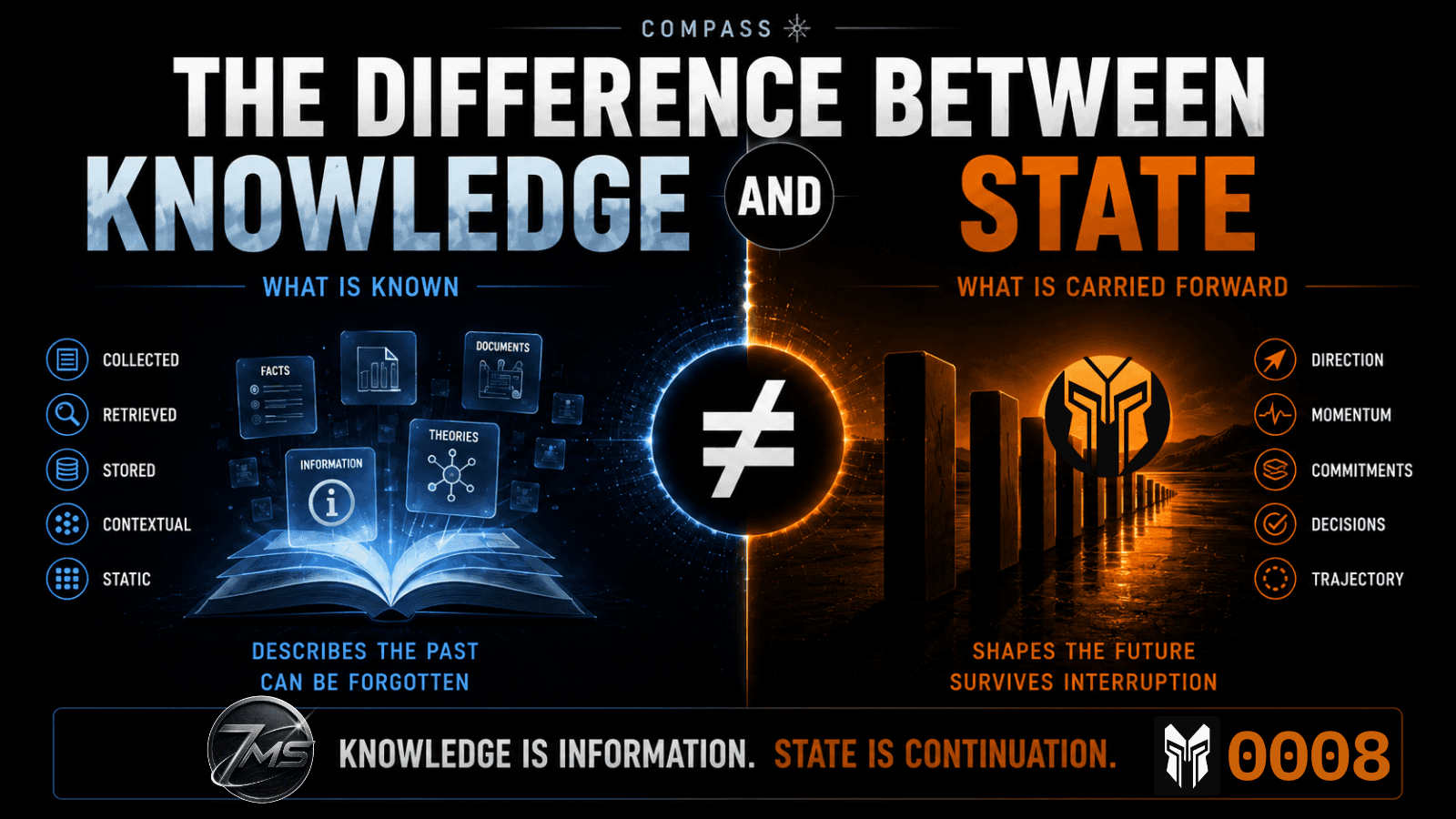
Because the project does not depend solely on information.
It depends on state.
The active objective.
The unresolved boundary.
The current direction.
The next move.
The trajectory.
A Million Tokens Is Still Storage
A common assumption is that sufficiently large context windows eventually solve continuity.
But increasing storage does not automatically create state preservation.
A million tokens still represent:
Continuity requires:
These are different categories.
One stores.
One continues.
The Book Analogy
Imagine reading a thousand-page book.
Now imagine the entire book remains visible at all times.
Every page.
Every chapter.
Every note.
Every detail.
You still need to know:
Where did I leave off?
Without that answer, continuity weakens.
The book is visible.
The progression is lost.
The Real Bottleneck
The bottleneck is not necessarily information capacity.
The bottleneck is preserving enough state for a process to continue.
The challenge is not remembering everything.
The challenge is preserving what matters.
Continuity Systems
A continuity system asks a different question.
Instead of asking:
How much can be stored?
It asks:
What must survive?
The distinction is subtle.
But it changes the architecture entirely.
One path produces larger storage systems.
The other path produces continuity systems.
The Compass Perspective
Context windows are useful.
They are important.
They will continue growing.
But continuity cannot be reduced to storage capacity.
A larger context window can delay continuity collapse.
It cannot eliminate it.
The future of long-running reasoning systems may depend less on how much information remains visible and more on whether the system can preserve the state required for reasoning to continue.
That is a different problem.
And it requires a different kind of solution.
Temporal Continuity
Previous Snapshot
• The Difference Between Knowledge and State
Related Seam
• AI Continuity vs AI Memory
Related Compass
• Why AI Memory Is Solving The Wrong Problem
• Why GPT Forgets Long Projects
Related Doctrine
• What Is Memex?
• Continuity Is a Runtime Problem