

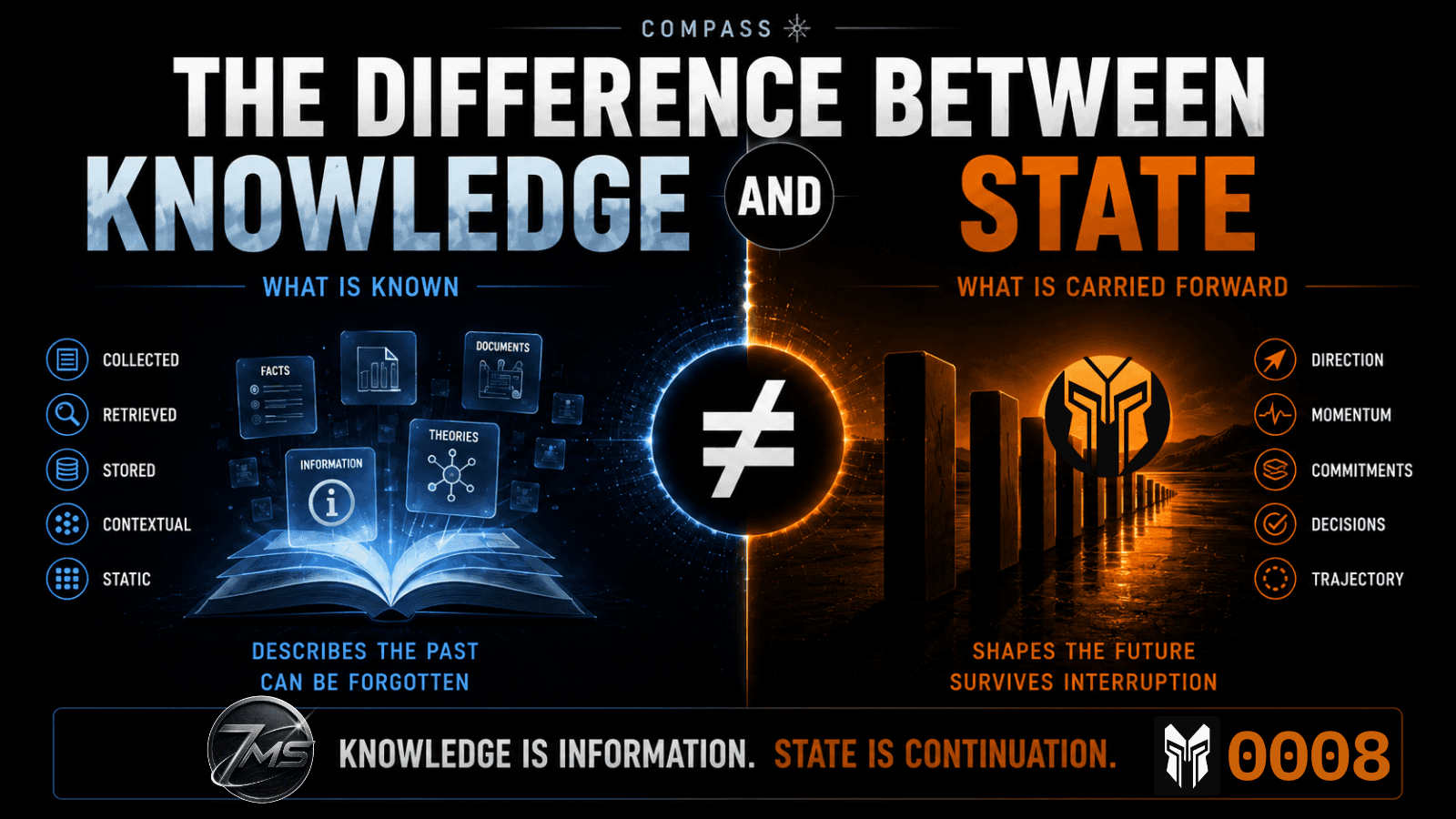
The Difference Between Knowledge and State
Knowledge explains what is true. State explains what is happening. Most AI systems preserve knowledge. Continuity systems must preserve state.
by
Most discussions about AI assume that intelligence improves when a system knows more.
This seems reasonable.
Knowledge is valuable.
Knowledge allows a system to answer questions, recognize patterns, and make decisions.
But knowledge alone does not create continuity.
To understand why, we need to distinguish between two concepts that are often treated as the same thing:
knowledge
state
They are related.
They are not identical.
Knowledge answers:
What is true?
Examples include:
Paris is the capital of France.
A repository contains 500 files.
A project uses TypeScript.
A design decision was made last week.
Knowledge describes reality.
It captures information.
Knowledge is incredibly useful.
But it does not tell us what is currently happening.
State answers:
What is happening?
Examples include:
Which problem is currently being solved?
What remains unresolved?
Where did work stop?
What is the next move?
What tension is driving the project forward?
State describes position within a process.
It captures progression.
State is temporal.
Knowledge is informational.
Imagine two people reading the same book.
The first person has perfect knowledge.
They know every character.
Every chapter.
Every plot point.
The second person knows much less.
But they know exactly where they left off.
Which person can continue reading immediately?
The second.
Because continuation depends on state.
Not merely knowledge.
Long-running projects rarely fail because all knowledge disappears.
More often:
objectives become unclear
priorities drift
unresolved questions vanish
momentum fragments
execution context collapses
The project still contains information.
What disappears is state.
The team knows many things.
But nobody knows exactly where the work exists within its trajectory.
An AI system can know:
project requirements
previous decisions
architecture documents
historical conversations
Yet continuity still fails.
Why?
Because knowledge does not preserve position.
Knowledge describes the landscape.
State describes where you are standing.
A useful way to think about state is momentum.
Knowledge tells you what exists.
State tells you where movement is occurring.
A continuity system therefore needs to preserve more than information.
It must preserve direction.
Pressure.
Trajectory.
Unresolved boundaries.
The active shape of the work.
If we confuse knowledge with state, we end up building systems that remember more but continue less.
The archive grows.
Continuity does not.
The result is familiar:
repeated onboarding
repeated explanations
repeated decisions
repeated mistakes
The system remembers.
The work still restarts.
Once the distinction becomes clear, a different question emerges.
Instead of asking:
How much knowledge should be preserved?
We begin asking:
What state must survive for continuity to remain intact?
That question points toward continuity systems rather than memory systems.
Knowledge is important.
But continuity depends on state.
A system can lose knowledge and still continue.
A system can preserve knowledge and still lose the thread.
The future of persistent reasoning may depend less on what a system knows and more on whether it can preserve the state required to keep moving.
That distinction changes how continuity is understood.
And it changes what should be preserved.
Previous Snapshot
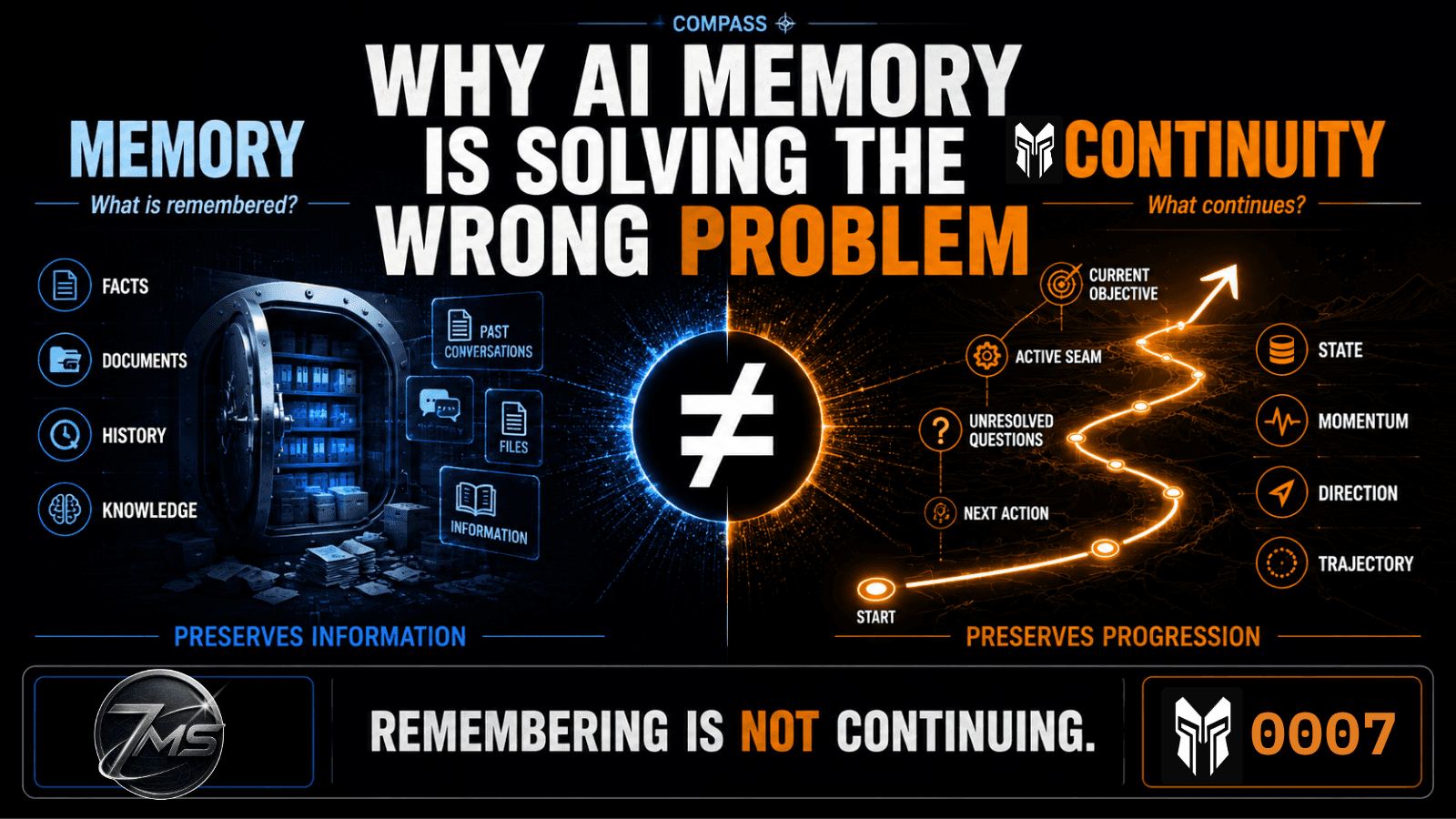
• Why AI Memory Is Solving The Wrong Problem
Related Seam
Related Compass
• Why GPT Forgets Long Projects
• The Real Problem Isn't AI Memory — It's Continuity Collapse
Related Doctrine