

Why AI Agents Still Restart
AI agents can plan, execute, search, and take action. Yet many still struggle with long-running projects because autonomy is not the same thing as continuity.
by
AI agents are everywhere.
Every week brings new demonstrations.
Agents that browse websites.
Agents that write code.
Agents that perform research.
Agents that complete tasks with minimal supervision.
The promise is compelling.
Give the agent a goal.
Let it work.
Receive the result.
As these systems improve, a common assumption has emerged:
More capable agents will naturally solve continuity.
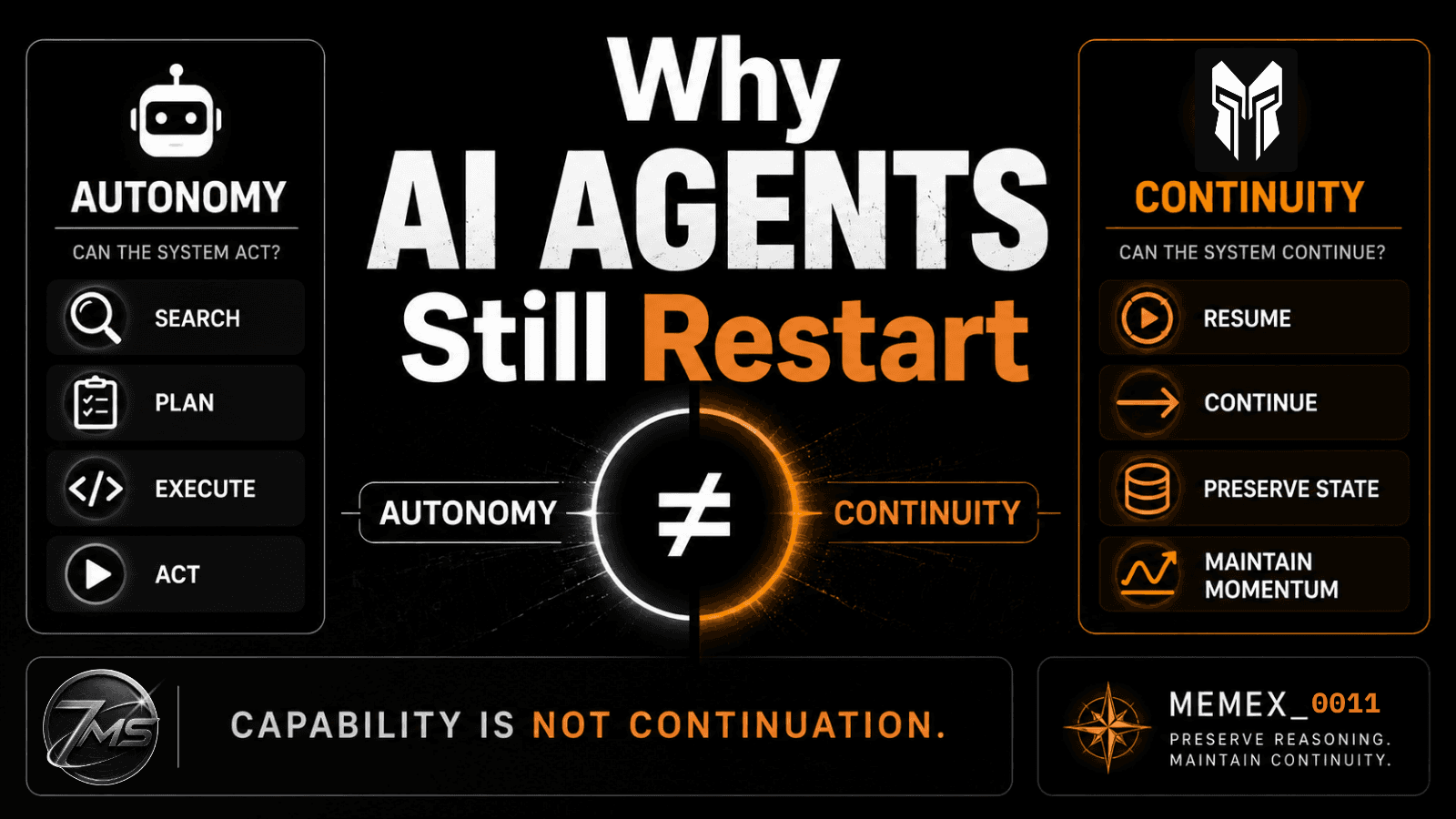
But capability and continuity are not the same thing.
Agents solve an important problem.
Action.
Traditional AI systems primarily answer questions.
Agents take action.
They can:
search
browse
plan
execute
iterate
coordinate tools
This is a significant step forward.
But action alone does not create continuity.
The logic often looks like this:
The conclusion feels reasonable.
Yet many long-running projects still experience the same failure pattern.
The agent succeeds.
The session ends.
The work restarts.
Imagine a construction crew.
The crew is highly capable.
Every worker is skilled.
Every tool functions perfectly.
The team can build almost anything.
But each morning they arrive with no idea what happened the day before.
No awareness of unfinished work.
No understanding of current priorities.
No knowledge of active constraints.
The workers are capable.
The project still restarts.
Capability is present.
Continuity is missing.
Most continuity failures do not happen because an agent cannot act.
They happen because a project extends beyond a single execution cycle.
Projects accumulate:
unresolved questions
active decisions
changing priorities
unfinished work
architectural pressure
Over time, these become more important than any individual action.
The challenge shifts from execution to continuation.
A restart is expensive.
Not because information disappears.
Because momentum disappears.
Every restart forces the system to reconstruct:
context
priorities
objectives
active boundaries
current direction
The project may still exist.
The trajectory becomes harder to recover.
Autonomy answers:
Can the system act?
Continuity answers:
Can the system continue?
These questions are related.
They are not identical.
A system can be highly autonomous while still struggling to maintain continuity across time.
As agents become more capable, the bottleneck changes.
The challenge is no longer:
Can the system perform work?
The challenge becomes:
Can the system preserve enough state for work to continue?
This is a different category of problem.
It requires different assumptions.
And likely different architecture.
The future of AI will almost certainly involve agents.
They will become faster.
More capable.
More autonomous.
More reliable.
Yet even perfect execution does not automatically create continuity.
The ability to act and the ability to continue are distinct capabilities.
Understanding that distinction may become increasingly important as AI systems move from isolated tasks toward long-running projects.
The goal is not simply to build systems that can do work.
The goal is to build systems that can continue work.
A highly capable agent that repeatedly restarts remains trapped in short-term execution.
A continuity-aware system preserves the trajectory itself.
The future of long-running AI projects may depend less on how much an agent can do and more on whether it can preserve the conditions required to continue.
That is the difference between execution and continuity.
And the difference becomes more important as projects grow longer.
Previous Snapshot
• Why RAG Doesn't Solve Continuity
Related Seam
Related Compass
• Why Context Windows Will Never Solve Continuity
• The Difference Between Knowledge and State
Related Doctrine
• Continuity Is a Runtime Problem